Triple Whale Review: The Best Shopify Attribution Tool in 2026?


TL;DR Triple Whale is the best analytics and attribution platform built for Shopify DTC brands. If you're running paid media across Meta, Google, and TikTok and making budget decisions based on what each platform self-reports, you're working with bad data. Triple Whale fixes that with first-party attribution, a unified profit dashboard, and creative analytics that tell you what's actually driving revenue. I use it daily — for attribution, performance reporting, creative testing on Meta, and Klaviyo optimization via Sonar Send. For brands spending $30K+/month on paid media, it's one of the highest-ROI tools in the stack.
Score: 9/10
The Honest Framing
I switched to Triple Whale because I was making budget decisions based on platform-reported ROAS that didn't reflect reality. Meta said one thing. Google said another. Shopify showed a completely different number. All three were technically right by their own attribution logic — and all three were wrong in a way that mattered.
The problem is structural. Each ad platform attributes conversions to itself using its own model, its own lookback window, and its own rules. They're all counting the same sales differently, and they're all incentivized to show you the best possible version of their own performance. After iOS 14.5 gutted third-party cookie tracking in 2021, the gap between platform-reported data and reality got significantly wider. Most Shopify stores are still running on that broken data today.
I needed a single source of truth that sat outside the walled gardens. That's what Triple Whale is.
What I didn't expect was how much I'd use the creative analytics side. I now use Triple Whale's Creative Cockpit as part of my Meta creative testing framework — seeing which specific hooks, formats, and angles drive actual revenue, not just clicks. That feeds into how I brief creative, generate image variants, and write video scripts. Triple Whale also sends attribution signals back to Meta to improve algorithmic targeting over time. It's not just a reporting layer — it actively improves campaign performance.
I also use Sonar Send to enrich Klaviyo flows with Triple Whale attribution data. That alone has meaningfully improved email performance.
It's not a cheap tool at scale. But the cost of making wrong budget decisions is significantly higher than the subscription.
What It Does Well
First-Party Attribution (The Triple Pixel)
The Triple Pixel is the foundation of everything Triple Whale does. It's a first-party tracking script installed directly on your Shopify store that captures conversion data independently of any platform pixel — no third-party cookies, no reliance on Meta or Google self-reporting.
The result is attribution data that holds within 5–10% variance of your actual Shopify net sales over a 14–28 day window. That's a level of accuracy you cannot get from platform dashboards alone, especially post-iOS 14.5.
This is the primary reason to use Triple Whale. Everything else is built on top of it.
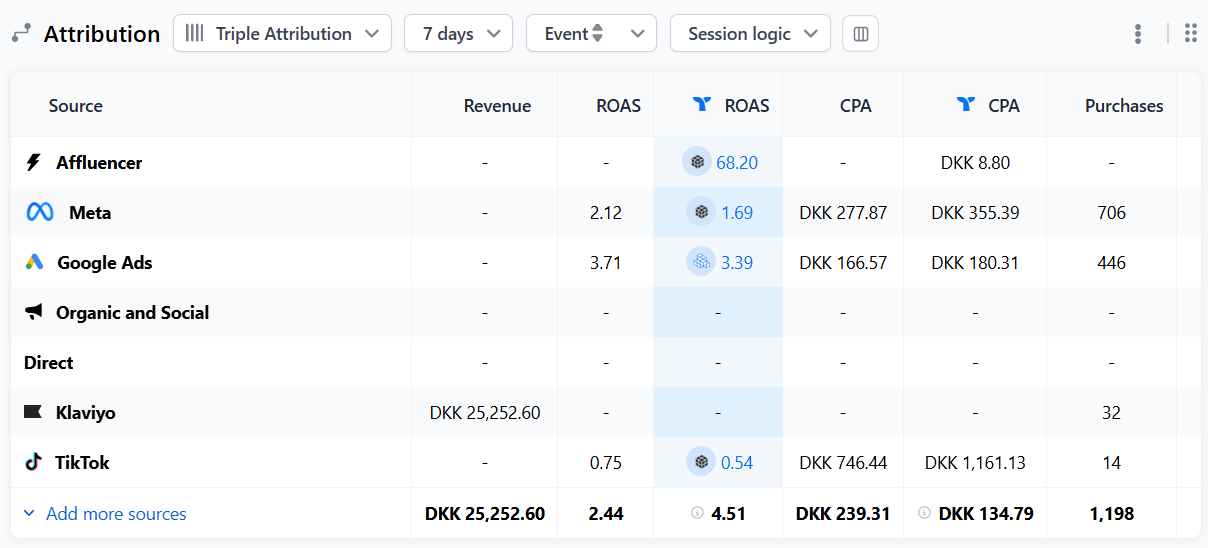
Look at the attribution table below from my actual account. Meta self-reports a 2.12 ROAS. Triple Whale's Triple Attribution model shows 1.69. That gap — across every channel simultaneously — is exactly why you can't make reliable budget decisions from platform dashboards alone.
The Summary Dashboard
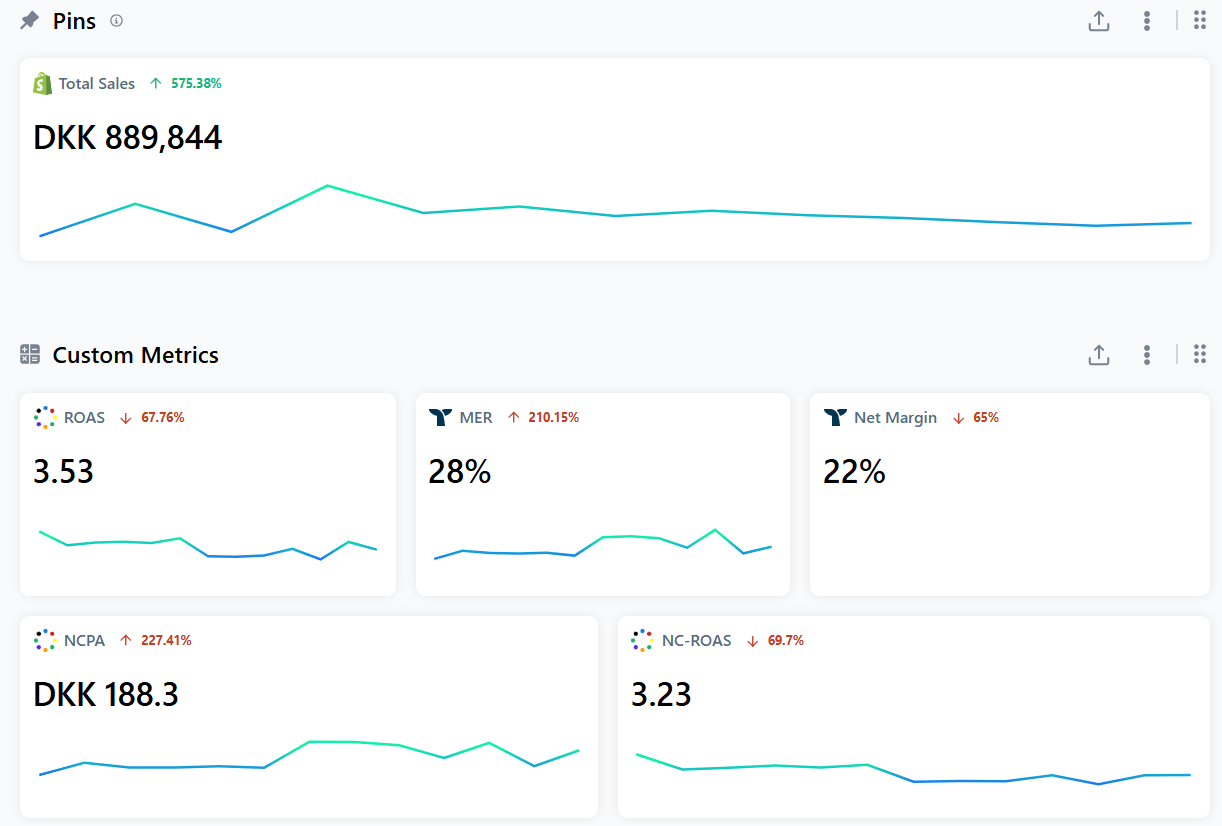
The Summary Page consolidates all your key metrics — revenue, ad spend, blended ROAS, MER, net margin, new vs. returning customer split — into a single real-time view. No more tabbing between Shopify, Meta Ads Manager, Google Analytics, and your email platform and trying to mentally reconcile numbers that don't agree.
For anyone running multi-channel paid media, this alone saves hours every week and eliminates a significant source of decision-making error.
Compass (Multi-Model Attribution)
Compass combines three attribution methodologies in one framework: Multi-Touch Attribution (MTA), Media Mix Modeling (MMM), and incrementality testing. Instead of picking one model and hoping it's right, Compass runs all three and lets you triangulate.
This matters because every attribution model has blind spots. Last-click undervalues top-of-funnel. First-click overstates awareness channels. MTA alone can be gamed by high-frequency touchpoints. Running all three and looking for where they converge gives you a level of confidence no single model can provide.
It has a learning curve. Give it 90 days of clean data before drawing hard conclusions.
Creative Cockpit
This is the feature I use most beyond core attribution. Creative Cockpit pulls performance data at the individual ad level across Meta, TikTok, and Google — showing which specific creatives are driving revenue, not just generating clicks or impressions.
I use it as the analytical backbone of my Meta creative testing framework. When I can see which hooks, formats, and visual angles are generating actual purchases, I brief better, generate better image variants, and write better video scripts. Triple Whale reads your creative library, tells you what's working and why, and feeds those attribution signals back to Meta to improve algorithmic performance over time.
Moby AI
Moby is Triple Whale's AI layer, trained on data from 50,000+ Shopify brands and over $82 billion in GMV. It analyzes your store's performance data, flags anomalies, and makes budget allocation and forecasting recommendations.
I use it heavily for creative work — generating ad variants, writing video hooks, optimizing Klaviyo flows, and working through email sequence logic. The chat history below shows what that looks like in practice. It's not a passive reporting tool — it's an active part of how I run creative testing and channel optimization.
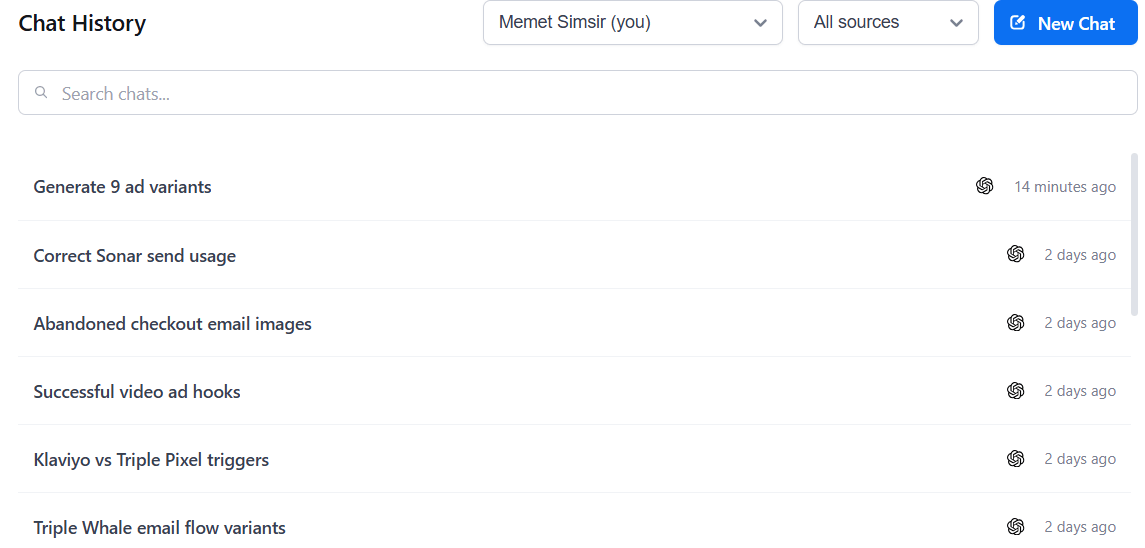
Moby gets significantly more useful the longer it runs. It needs 90+ days of data before the recommendations become reliably actionable. Don't judge it in the first month.
Sonar Send (Klaviyo Integration)
Sonar Send enriches Klaviyo flows with Triple Whale attribution data, so you can trigger email sequences based on which ad actually drove the purchase — not just that a purchase happened. This means smarter segmentation, more relevant post-purchase sequences, and better LTV optimization.
Triple Whale reports an average 14.2% lift in Klaviyo-attributed revenue for brands using Sonar Send. That figure comes from their own data, so treat it as directional — but in my experience the enriched attribution data meaningfully improves what you can do with flows.
For more on getting the most out of Klaviyo, see my Klaviyo review.
Profit Dashboard
The Profit Dashboard shows actual profitability — factoring in COGS, shipping costs, ad spend, platform fees, and refunds. You see real margin by channel, by campaign, and by product.
A campaign with a 3.2x ROAS can still be unprofitable once you factor in fulfillment costs and fees. The Profit Dashboard shows you that before it becomes a problem.
Customer LTV and Cohort Analysis
Triple Whale tracks how customers acquired in a given month spend over 30, 60, 90, 180, and 365-day windows. This cohort view is essential for understanding true payback periods and making smart decisions about acceptable CAC. If you're optimizing purely for first-order ROAS without understanding downstream LTV by acquisition channel, you're leaving real money on the table.
What It Doesn't Do As Well
Pricing scales steeply at higher GMV. Triple Whale's pricing is GMV-based, which means costs rise with revenue regardless of how many features you're actively using. At higher tiers this becomes a meaningful line item.
Compass takes time to interpret correctly. Multi-model attribution is genuinely more accurate than any single model — but it requires a mindset shift if you're used to reading one ROAS number and acting on it. Expect several weeks before you're using it confidently.
Moby AI needs 90+ days of data. New stores won't get full value from the AI layer immediately. Worth knowing upfront.
Under $10K/month in ad spend, the free plan is probably enough. The paid tiers are built for brands with meaningful media budgets. Below that threshold, the incremental value over the free plan is harder to justify.
Not a replacement for Google Analytics. Triple Whale focuses on paid media attribution and ecommerce profitability. GA4 still has value for organic traffic, SEO, and on-site behavior. Most serious brands run both.
Who It's For
Triple Whale is the right tool if:
- You're spending $30,000+/month on paid media across two or more channels
- You're making budget allocation decisions and need data you can actually trust
- You're running a creative testing program on Meta or TikTok and want revenue-level performance data at the ad level
- You're using Klaviyo and want to improve flow performance with attribution-enriched data via Sonar Send
- You need real profitability visibility — not just revenue and ROAS
Who It's Not For
Skip the paid tiers if:
- You're spending under $10,000/month on ads — use the free plan and revisit when you scale
- You're running a single ad channel only — native analytics will cover you at that stage
- You need a simple profit tracker — lighter tools like Reaktion cover basic profitability at a lower price point
Pricing
Triple Whale has four tiers. The free plan is genuinely useful — not a stripped-down teaser. The paid tiers scale by GMV, so your cost goes up as your store grows regardless of feature usage. Annual billing gets you two months free, which matters at the Foundation tier and above.
| Plan | Price | Key Features |
|---|---|---|
| Free | $0/month | Blended analytics, first/last-click attribution, post-purchase surveys, up to 10 users, 12-month lookback |
| Foundation | From $219/month | Triple Pixel multi-touch attribution, custom dashboards, customer segments, Moby AI |
| Automate | From $749/month | Correlation analysis, forecasting tools, deeper campaign insights, automated recommendations |
| Enterprise | Custom quote | Custom requirements, agency portals, dedicated support, data warehouse syncs |
For most Shopify brands the Foundation plan at $219/month is the right starting point — it's where the Triple Pixel and Moby AI unlock. The Automate tier makes sense once you're running serious forecasting and need correlation analysis across campaigns. All prices scale with GMV — what you see above is the entry point for each tier. Confirm exact pricing for your GMV tier directly with Triple Whale before committing.
My Verdict
9 / 10
Triple Whale is the tool I'd find hardest to remove from my stack. The Triple Pixel alone justifies the cost if you're running meaningful paid media — making budget decisions on platform-reported data is one of the most expensive mistakes a DTC brand can make, and Triple Whale is the most reliable fix for it.
But the value goes beyond attribution. The Creative Cockpit has changed how I approach Meta creative testing. Seeing revenue-level performance at the individual ad level — not just CTR or CPM — means I brief better, test smarter, and waste less money on creative that looks good but doesn't convert. The signals Triple Whale feeds back to Meta improve algorithmic performance over time. Moby AI has become a genuine part of my creative workflow — generating ad variants, writing video hooks, and optimizing Klaviyo flows. And Sonar Send has made my email flows meaningfully more effective without requiring a separate tool.
The pricing scales steeply at higher GMV and Compass takes time to use confidently. Neither is a reason not to use it — they're just things to go in with eyes open about.
For Shopify brands running serious paid media across multiple channels, this is as close to a required tool as the stack gets.
The Bottom Line
If you're spending real money on paid ads and still making decisions based on what Meta, Google, and TikTok report about themselves, you're working with fundamentally unreliable data. Triple Whale fixes that — and then gives you a creative analytics layer, a profit dashboard, AI-driven insights, and Klaviyo enrichment on top of it.
Start with the free plan. If you're at $30K+/month in ad spend, upgrade to Foundation and give it 90 days. The clarity it brings to budget allocation decisions will pay for itself.
For a direct comparison with a lighter-weight analytics alternative, see my Triple Whale vs Reaktion breakdown.
Frequently Asked Questions
Is Triple Whale free?
Yes. The free plan is genuinely useful — not a crippled trial. It includes blended analytics, first/last-click attribution, post-purchase surveys, up to 10 users, and a 12-month lookback. Every Shopify brand running paid ads should be using it.
How much does Triple Whale cost?
Paid plans start at $219/month for the Foundation tier. The Automate plan starts at $749/month. Both scale with GMV. Annual billing saves you two months versus monthly. Confirm current pricing for your revenue tier directly with Triple Whale.
Is Triple Whale worth it for small stores?
The free plan is worth it for everyone. Paid tiers make the most sense once you're spending $30,000+/month on paid media across multiple channels. Below that, the incremental value over the free plan is harder to justify.
How accurate is Triple Whale's attribution?
Under consistent attribution models and windows, Triple Whale maintains variance vs. Shopify net sales within 5–10% over a 14–28 day window. That's significantly more accurate than relying on any single platform's self-reported numbers. The attribution table in this review shows the gap in practice — Meta self-reports 2.12 ROAS, Triple Whale shows 1.69.
What is Sonar Send and is it included?
Sonar Send enriches Klaviyo email flows with Triple Whale attribution data, enabling smarter segmentation and more relevant post-purchase sequences. Triple Whale reports an average 14.2% lift in Klaviyo-attributed revenue for brands using it. Check with Triple Whale on which plan includes it for your tier.
Does Triple Whale replace Google Analytics?
No — and it doesn't try to. Triple Whale focuses on paid media attribution and ecommerce profitability. GA4 still has value for organic traffic, SEO, and on-site behavior analysis. Most serious brands run both in parallel.
How does Triple Whale compare to Northbeam?
Both are serious attribution platforms built for DTC brands. Northbeam is stronger on enterprise-scale media mix modeling. Triple Whale wins on Shopify-native integration depth, creative analytics, the Klaviyo Sonar Send connection, and overall ease of use for most DTC operators. For most Shopify brands, Triple Whale is the better starting point.