Product Bundling Strategy: How Better Offers Help Shopify Stores Scale


TL;DR
Product bundling is one of the most useful ways I’ve found to improve an ecommerce offer without relying on another price cut. A good bundle can increase what a customer buys, make the purchase feel more valuable, move inventory faster and—if the added order value also produces more contribution—give you more room to acquire customers through paid advertising. I use Shopify bundles on my own store for quantity breaks, physical and digital gifts, and complementary offers; the important caveat is that higher revenue or AOV only matters if the economics underneath the larger order still work.
The honest framing
I run Babysleepy.dk, a Danish Shopify store selling baby products, and the examples in this article come from offers I have actually built, products I have tested and inventory decisions I have had to make. The screenshots are from my own storefront and Kaching account. They are here to support the strategy rather than turn this into another app review.
I have personally used quantity offers, physical gifts, digital gifts and complementary product combinations. I have not personally tested every larger-volume structure discussed later, so I will distinguish those ideas from what I have actually done. If you mainly want the feature-by-feature assessment of the app, I cover that separately in my Kaching Bundles review. This article is about the product bundling strategy behind the setup.
Why product bundling is really an offer strategy
The easiest way to misunderstand product bundling is to think it is just another trick for increasing average order value. It can certainly do that, but the more important effect is that you are changing the offer the customer evaluates.
That matters in a competitive market. If you and a competitor both sell a similar product for DKK 429, you can keep responding to each other by lowering the price. But eventually you are competing almost entirely on who is willing to accept less margin.
Bundling gives you another option. You can keep the single-product price at DKK 429 and make the purchase itself more attractive: offer two at a better effective price, add a relevant gift, include useful digital content or combine the product with something that solves a related problem.
The comparison is no longer simply:
DKK 429 versus DKK 429
It becomes:
What do I actually get for DKK 429?
That is what I mean by improving the offer. You are giving the customer another reason to choose you without automatically devaluing the main product.
There is also a timing difference between a product bundle and other forms of upselling. A cart upsell appears after someone has already added something. A post-purchase offer comes after the first sale has been made. A bundle on the product page is part of the proposition that has to earn the original purchase.
That is why I consider product bundling part of conversion rate optimisation rather than something that happens afterwards.
The connection between bundles, conversion and paid acquisition
I think about conversion optimisation in two parts. First, you need to turn a visitor into a customer. Then you need to make the economics of that conversion as strong as reasonably possible.
Conversion rate tells you how often visitors become customers:
Conversion rate = Orders ÷ Visitors
Average order value tells you how much an order is worth:
AOV = Revenue ÷ Orders
Together, those numbers affect how much revenue your traffic produces:
Revenue per visitor = Conversion rate × AOV
Imagine 100 visitors generate five orders averaging DKK 500. That produces DKK 2,500 in revenue. If the same traffic still produces five orders but a better offer takes the average order to DKK 650, revenue becomes DKK 3,250.
You did not buy another visitor. You changed what happened when the visitor purchased.
Revenue alone is not enough, though. The larger order also brings additional costs, which is why I care more about the contribution left after supplying it.
Pre-ad contribution = Net order revenue − product and gift costs − fulfilment costs − payment and other variable fees
Suppose an ordinary first order produces DKK 200 of contribution before advertising. A better bundle produces DKK 270. If you want to retain DKK 80 for fixed costs and profit in either case, your theoretical room for acquiring that customer has increased from DKK 120 to DKK 190.
That is the part of product bundling I find most interesting.
You do not always need to acquire the customer for less. Sometimes you need to make acquiring the customer worth more.
When you are trying to scale, that matters. Your ability to spend on Meta or capture high-intent demand through Google ultimately depends on the economics of the customers you acquire. A better offer does not automatically mean you should increase your ad spend, but if it leaves more contribution per customer, it can give you more room to compete for the next one.
This is why I do not see the offer and the advertising strategy as separate. The economics of the offer help determine how aggressively the business can acquire traffic.
Which type of product bundle should you use?
There is no reason to add every type of bundle to every product. Start with the commercial problem you are trying to solve.
| Situation | Bundle worth testing | What needs to be true |
|---|---|---|
| Customers reasonably need multiple units | Quantity break | The larger order remains worthwhile after the discount |
| You have relevant inventory that is not moving | Free gift | The gift improves the offer enough to justify giving it away |
| You have products that genuinely complement one another | Complementary bundle | The combination makes the purchase easier or more useful |
| Customers naturally buy in large quantities | Volume offer | The total contribution justifies the lower unit price |
I use Kaching Bundles to implement these offers on Babysleepy. The important order is strategy first, software second: decide what would make the purchase better, calculate what you can afford to give away, and then configure the Shopify bundle app around that decision.
1. Quantity breaks: turn efficiency into customer value
My SleepySack offer is a good example because it does more than put a percentage discount beside a larger quantity.
The customer can buy one SleepySack for DKK 429 or two for DKK 809. Two purchased individually at the current single-unit price would cost DKK 858, so the two-unit option creates an additional DKK 49 saving. The offer also explains why someone might reasonably want two—having a spare and being ready as the baby grows—and the larger option includes two gift selections.
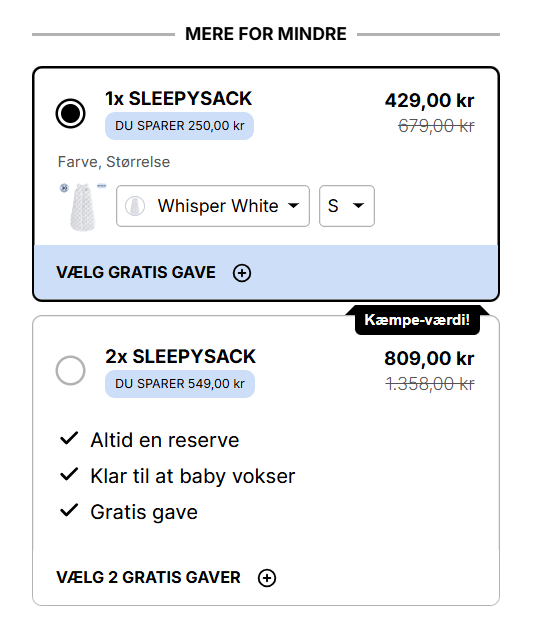
The deeper point is the fulfilment economics. If I ship one sleeping bag, I have already incurred an order-level shipping cost. When two units fit into the same parcel, the second unit may increase the weight and price of that parcel, but it does not necessarily require a completely separate shipment.
That can create an efficiency. You can keep all of that efficiency as margin, or you can give some of it back to the customer through the quantity offer. That is a much better starting point for bundle pricing than choosing an arbitrary discount because 10% or 15% looks attractive.
The calculation I would make is: what genuinely becomes cheaper per unit when this customer buys more? Packaging, picking, payment costs and shipping can all behave differently at a two-unit order size. Work out the actual numbers and decide how much of the saving you can use to improve the offer.
There is also a cash-flow consequence. When a bundle genuinely brings forward an additional unit sale, you convert more inventory into cash in the same transaction. That can help you reorder winners or reinvest sooner, although you still need enough working capital to replace the inventory you are selling through.
The screenshot illustrates another practical benefit as well: the bundle gives the offer more product-page real estate. The visitor has something meaningful to consider—one or two, the saving, the gifts and the practical reasons for taking the larger option—instead of immediately scrolling past the price and Add to Cart button.
I would not take that logic too far. A huge bundle widget with endless options can produce choice overload instead of more consideration. The goal is to hold attention because the offer is worth considering, not because the interface is difficult to escape.
2. Free gifts: give unsuccessful inventory another job
The free-gift strategy came out of my product testing.
My SleepySack and HipHug became successful products. StepWise sensory stepping stones and BumperBuddy did not perform the same way as standalone products, which left me with inventory that I had already paid for and still had to store.
Instead of continuing to ask how I could force those products to work independently, I changed the question:
Can this inventory help me sell something that already works?
I first used StepWise products as free gifts. After that stock was cleared, I started using BumperBuddy in gift offers as well.
That does not undo a failed product test. The original inventory cost is still real, and giving the product away does not recover that money directly. But once the product has failed as a standalone offer, the relevant decision changes. I can continue paying to hold it, discount it independently, find another outlet or use it to improve the conversion proposition of a winning product.
That is why I think a failed SKU can still become useful inventory.
My current gift selector also shows why a gift does not have to be a physical product.
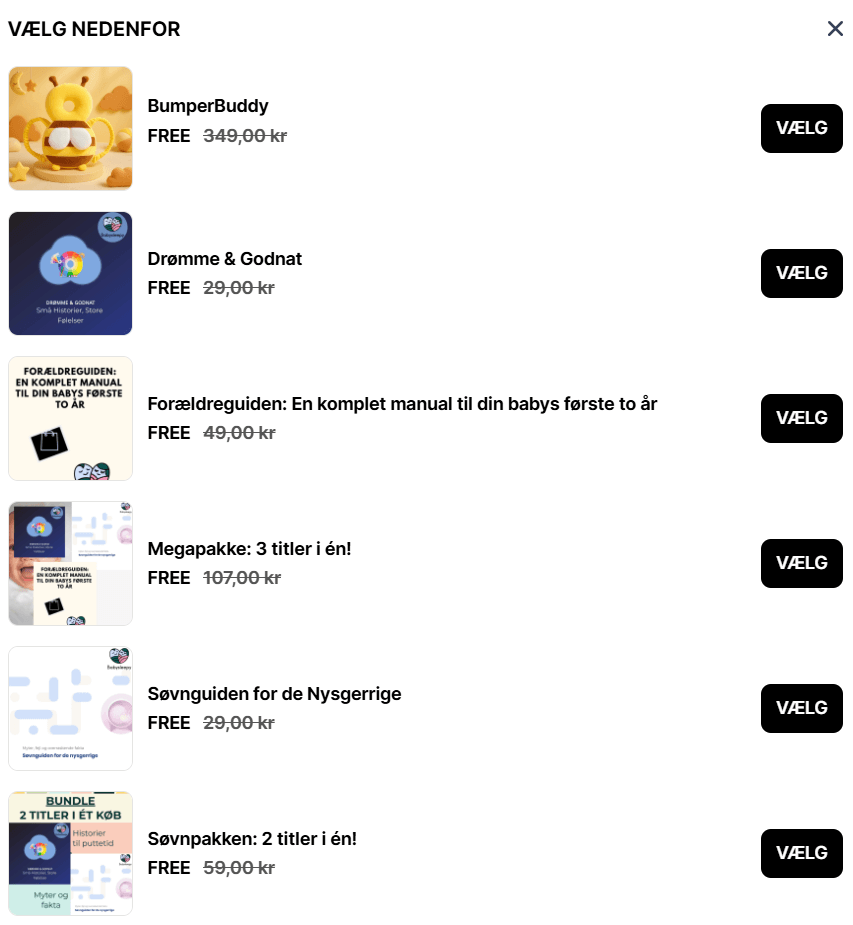
I have written three or four e-books myself. Once the content exists, delivering another copy does not require another physical unit or add weight to the shipment. There is still a cost to creating and maintaining good content, but the marginal delivery economics are very different from those of a physical product.
That creates what I think of as value asymmetry: something can be genuinely useful to the customer while costing relatively little for the merchant to provide again.
The same thinking can apply to a checklist, tutorial, printable guide or another piece of useful niche-specific content. A physical item you already own may also have low economic value sitting in your warehouse while still having meaningful perceived value to the customer.
You can get creative with presentation too. A mystery gift is one option I would consider testing because surprise can create curiosity around the offer, although I would still make the qualifying purchase clear and ensure the customer receives something appropriate. “Mystery” should not be an excuse to get rid of something nobody wants.
The practical rule is simple: do not ask what the cheapest possible gift is. Ask what you can provide economically that the customer would actually value.
3. Complementary product bundles: sell the solution, not just the SKU
Product bundling does not always mean selling more of the same item. You can also combine products that solve related problems.
My HipHug offer is an example. HipHug is shown on its own for DKK 299, while the HipHug + BumperBuddy combination is DKK 499, with free shipping and a free parent guide included.
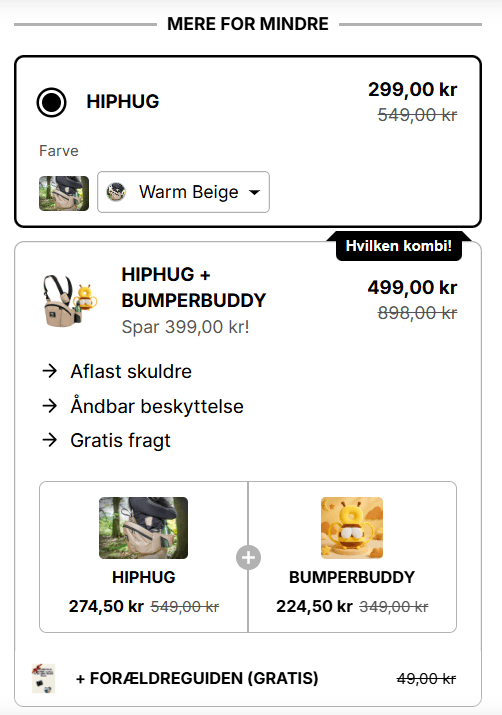
It is worth being precise here because I have used BumperBuddy in more than one way. In my gift selector it can be a free gift. In the HipHug offer above, BumperBuddy is part of the paid product combination; the parent guide is the free extra.
The broader opportunity appears as you build a focused niche store and bring in more successful products. Products that serve the same customer can often be grouped around a recognisable use case rather than presented as unrelated SKUs.
A baby store could, for example, create a Newborn Essentials bundle containing products that are genuinely relevant to that stage. That is an illustrative example rather than a specific offer I am claiming to have tested.
The value of a thematic bundle is partly convenience. Instead of asking the customer to browse the catalogue and decide what belongs together, you have already done some of that selection work.
This can also help make more use of paid traffic. I have repeatedly seen visitors arrive because of one product and ultimately buy another. An ad might get someone through the door without the advertised SKU being the final product they want.
That is one reason a focused niche can be valuable. The person may still be the right customer even when the first product is wrong. Relevant Shopify product bundles and alternative products give that visitor more than one path to conversion.
4. Larger volume offers: trade margin for a larger order
This is the type of bundling I have not personally tested to the same extent, so I would treat it as an option rather than a result from my store.
If you have enough margin and sell something customers naturally buy in quantity, you can experiment with offers such as buy three, pay for two, buy seven, pay for six or buy twenty, pay for eighteen.
This is still discounting, but I see an important difference between a volume incentive and repeatedly lowering your retail price. The customer is giving you something in return: a larger commitment. You reward that with a lower effective unit price.
The numbers still have to work. Twenty units for the price of eighteen is a 10% reduction from the full twenty-unit price, and a larger order is not automatically more profitable just because more products leave the warehouse.
There is also a secondary opportunity worth watching. If someone repeatedly exploits your largest volume tier and starts ordering unusually large quantities, they may not really be a normal retail customer. They could be purchasing for a business, organisation or resale operation.
That does not automatically make them a wholesale account, but it is a reason to start a conversation. A customer who entered through an ordinary Shopify bundle can sometimes reveal a potential B2B relationship through their buying behaviour.
What Kaching Bundles has generated on my store
I use Kaching as the execution layer for these offers. The strategy comes first; the app gives me a practical way to present it on the storefront and track what happens.
The account dashboard currently shows DKK 53,540 in added revenue from the bundle setup.
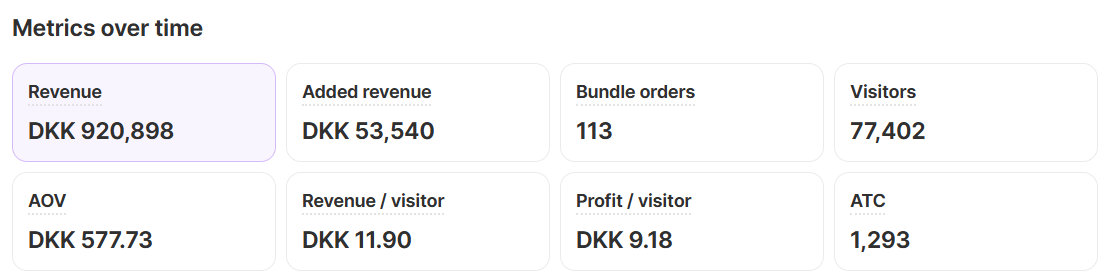
I deliberately do not publish the underlying reporting period when I share store analytics. The useful point here is not to reverse-engineer Babysleepy’s monthly sales; it is to show that customers are actually interacting with the offers described in this article.
The DKK 53,540 number also needs the right interpretation. Added revenue is not automatically added profit. A second SleepySack has a product cost. A physical gift has a cost. Discounts reduce what I collect per unit, and larger orders can change fulfilment costs.
That is why I would evaluate a Shopify product bundle using contribution rather than celebrating AOV in isolation.
Bundle contribution = Net bundle revenue − product and gift costs − fulfilment costs − payment and other variable fees
The bundle-level dashboard adds useful context because it separates the offers rather than hiding everything inside one total.
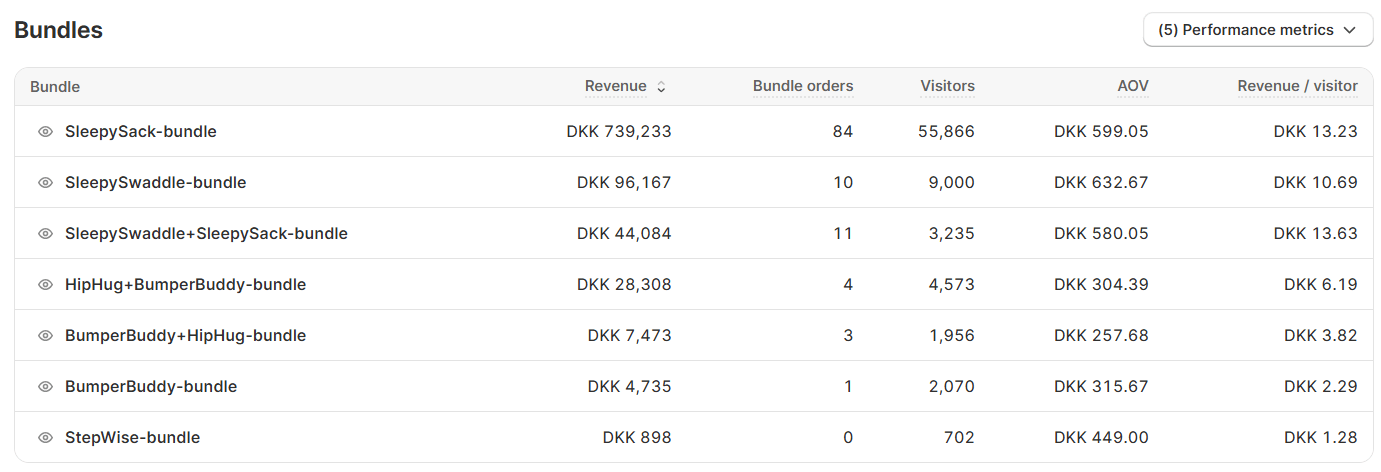
The SleepySack offer clearly accounts for most of the revenue shown in this view, while the other bundles contribute at very different levels. That does not automatically tell me which offer is most profitable, because the table does not contain the complete cost structure of each order. It does tell me where the bundle activity is happening and where I should look more closely.
If you want the app assessment rather than the strategy behind these offers, read my full Kaching Bundles review.
Want to build quantity breaks, free gifts or product bundles in Shopify?
How I would test a product bundling strategy
I would not install a Shopify bundle app and launch every possible offer at once. Start with the clearest opportunity in the business.
Take a product that already sells and establish what the normal order looks like. Then test one meaningful change: a quantity break, a relevant gift or a complementary combination. Keep the ordinary single-product purchase easy to understand so the larger offer does not damage the conversion you already have.
Then monitor what happens to the full economics. Did AOV increase? Did contribution per order increase? Did revenue per visitor improve? Did conversion deteriorate because the widget became harder to understand? Did you move inventory faster, and if so, do you have the working capital to replenish it?
A bundle is not successful merely because customers select it.
It is successful when the change improves the economics of the store enough to justify what you are giving away.
I would also avoid changing the advertising, bundle price, gifts and entire product page at the same time. If everything moves, you will struggle to understand what actually caused the result.
When product bundling does not make sense
There are cases where I would skip it.
If the customer has no sensible reason to own two units, a quantity break may just become noise. If the products do not genuinely complement each other, a mixed bundle can feel like you are trying to unload inventory. If the additional item dramatically increases dimensional shipping costs, the supposed fulfilment efficiency can disappear.
The same applies to gifts. A free product is not automatically valuable because you put “FREE” beside it. The gift still has to fit the customer and the purchase.
And there is a UX limit. Product bundles work best when they make the decision more attractive or easier. If the customer has to analyse seven tiers, six gifts and four combinations before finding the normal Add to Cart button, the bundle has probably started working against you.
Frequently asked questions
What is product bundling?
Product bundling means combining several products, units or benefits into one offer. In ecommerce, it is commonly used to improve perceived value, increase order size or make a multi-product purchase easier for the customer.
What are the main types of bundling?
The most useful types of bundling for my store are quantity bundles, free-gift offers and complementary product bundles. Volume-based “buy X, get Y” offers are another option when margins and natural purchase quantities support them.
How do you bundle products in Shopify?
You can bundle products in Shopify using Shopify’s own bundle functionality or a Shopify bundle app, depending on the offer you need. I use Kaching Bundles because my offers include product-page quantity choices, gifts and complementary combinations. My Kaching Bundles review covers the app in more detail.
Do product bundles increase average order value?
They can, but higher AOV is only useful when the larger order still produces acceptable contribution. Calculate the cost of the additional products, discount, gifts and fulfilment before deciding whether an AOV increase has actually improved the business.
Are bundles better than cart or post-purchase upsells?
They solve a different problem. A product-page bundle changes the offer before the first purchase decision, while cart and post-purchase upsells monetise intent later in the journey. If you want to see how I use those placements, read my Kaching Cart Drawer review and Kaching Post Purchase Upsell review.
The bottom line
The reason I use product bundling is not simply to increase AOV. It gives me another way to improve the offer when competing stores are selling similar products at similar prices.
A quantity break can turn part of a fulfilment efficiency into customer value. A free gift can give unsuccessful inventory a useful second role. Digital products can create value without another physical unit to ship, and complementary bundles can turn individual SKUs into a more complete solution.
The real growth effect appears when those changes leave more contribution from the customers you already acquire. That can improve cash flow, accelerate inventory turnover and give the business more room to compete for the next customer.
Before lowering your price again or simply increasing the Meta budget, look at your best-selling product and ask what could make the offer better. Then calculate whether you can provide it economically.
The next improvement in your acquisition economics may start on the product page, not in Ads Manager.
Build your first Shopify bundle with Kaching:
Read more
- My Kaching Bundles review — the app itself, including my hands-on assessment.
- My Kaching Cart Drawer review — increasing order value after the customer has shown purchase intent.
- My Kaching Post Purchase Upsell review — where post-purchase offers fit after the initial conversion.
- My Kaching Apps review — the wider Kaching Shopify app ecosystem.