The Ecommerce Metrics That Actually Matter When Scaling Your Business

The goal is not a high ROAS.
You can produce an excellent ROAS simply by spending almost nothing.
The real question is whether you can scale profitably. And to answer that, you need to understand the economics of the entire business — not just what one ad platform is telling you.
This is where a lot of new store owners go wrong.
They launch Meta ads, spend some money, look at the numbers inside Ads Manager, decide advertising does not work, and shut everything down.
That is far too narrow a way to look at the business.
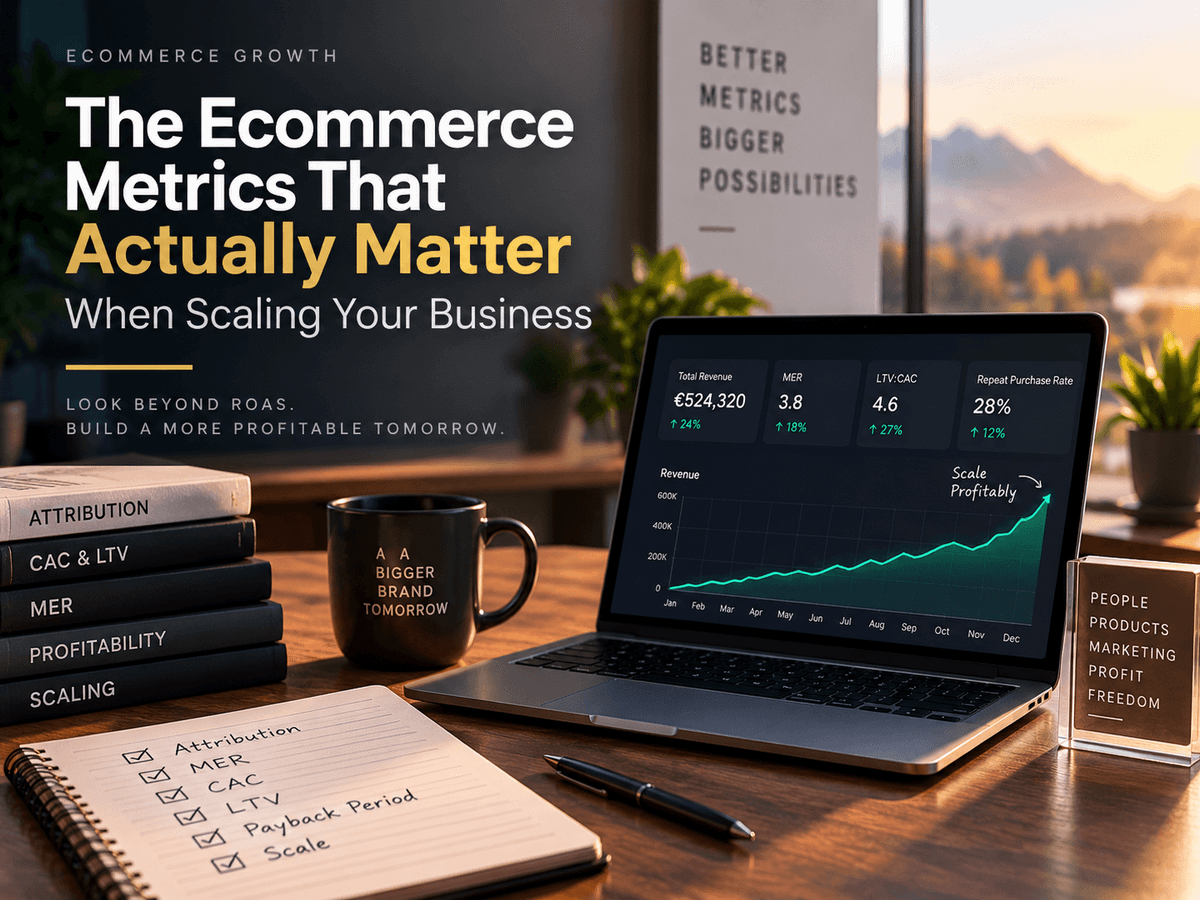
When I think about whether a store is ready to scale, there are a handful of metrics I keep coming back to:
- ROAS and blended ROAS
- MER (marketing efficiency ratio)
- Customer acquisition cost (CAC)
- Customer lifetime value (LTV)
- LTV:CAC ratio
- Payback period
- Conversion rate
- Repeat purchase rate
But before any of those numbers mean anything, you need one thing first.
A reliable attribution layer.
Because if you cannot trust the data, none of the metrics matter.
Start with attribution, not the ad platforms
One of the most common mistakes I see with newer stores is relying on the reporting inside Meta, Google or other advertising platforms.
I do not use those numbers as my source of truth.
The platforms are useful for running campaigns. They are not where I want to evaluate the performance of the business.
Every advertising platform has its own attribution model. Meta may claim a conversion. Google may claim the same conversion. Klaviyo may also attribute revenue to an email sent two days earlier.
If you try to evaluate the business by jumping between those dashboards, you are never looking at one consistent version of reality.
That is why I prefer one attribution layer.
Triple Whale is the obvious choice for many Shopify stores. It pulls in spend from Meta, Google and your other channels, combines that with your Shopify revenue data, and gives you one place to evaluate performance.
For larger brands with more complex requirements, Northbeam is worth considering. For smaller stores, simpler tools exist.
The specific platform matters less than the principle:
You need one place where you evaluate the entire business.
ROAS: useful but limited
ROAS means return on ad spend.
Revenue attributed to a channel ÷ spend on that channel
If your attribution platform attributes €2,500 in revenue to Meta on €1,000 of spend, your ROAS is 2.5.
That is a useful number for understanding the efficiency of a specific channel.
But I would never look at one channel in isolation and use that to decide whether the business is doing well.
Meta may show a ROAS of 2. Google may show 5. Affiliates may effectively be generating a ROAS of 4. Email is generating revenue from customers you already acquired months ago.
Individual channel ROAS helps you understand the role of each channel. It does not tell you whether you can scale the company.
For that, you need to zoom out.
ROAS vs MER: the number that actually tells you whether to scale
MER stands for marketing efficiency ratio.
MER = Total revenue ÷ total marketing spend
Blended ROAS is often used in a very similar way. Some businesses use the terms interchangeably. Others distinguish them based on what is included in the denominator — blended ROAS may cover paid media only, while MER sometimes includes a broader definition of marketing costs such as affiliates, agencies and creators.
The terminology is not the important part.
What matters is having one number that tells you:
For every euro I put into marketing, how much revenue is the business producing?
That is the number to watch when you are thinking seriously about scale.
A high ROAS on one channel can coexist with a weak MER if other channels are underperforming or your retention is poor. Equally, a Meta ROAS that looks modest may be perfectly acceptable if your affiliates and email are doing their job.
Do not judge the business by Meta alone
Meta is the primary engine for creating demand for most DTC brands. For most ecommerce businesses scaling paid media, it is where the majority of effort and spend belongs.
But Meta does not need to look beautiful in isolation.
A lot of new store owners expect Meta to produce a ROAS of 4 or 5 as they scale. That is not realistic for most brands spending meaningful amounts.
If you can scale substantial spend while maintaining a Meta ROAS above 3, that is already very strong.
Meta needs room. You need to test creatives. Some will fail. You need to let the algorithm learn. You need to replace creatives when they fatigue. Performance will move up and down.
That is normal. That is not a sign the business is broken.
The better question is:
How do I make the rest of the business efficient enough that I can afford to keep scaling Meta?
That reframes the entire marketing stack.
Meta vs Google: two different jobs
Meta is a push platform. You are showing your product to people who were not looking for it. Some may never have considered your product category. You are paying to reach them regardless.
That is why Meta becomes expensive as you scale. It is also why it is so powerful — it gives you access to enormous audiences and can introduce products to people who did not know they wanted them.
Google is different.
Someone searching on Google already wants something. They may know your brand. They may be searching for the problem your product solves. They are much further down the funnel.
That is why Google can often produce a higher ROAS. But you have to understand what role it is playing.
A customer may discover your brand on Meta, visit your store, leave, and then search for your brand on Google two days later. Google looks extremely efficient. Meta helped create that demand.
This is another reason why a proper attribution platform matters. The channels work together. They should not be treated as separate businesses.
CAC: what a customer actually costs
Customer acquisition cost tells you how much it costs to put a new customer into the business.
CAC = Acquisition spend ÷ number of new customers acquired
If you spend €10,000 and acquire 500 new customers, your CAC is €20.
But CAC does not tell you whether €20 is good or bad. To answer that, you need to understand what the customer is worth.
Customer lifetime value in ecommerce: the number that changes everything
Customer lifetime value — LTV or CLV — measures how much value a customer generates over their entire relationship with your business.
This is one of the most important numbers in ecommerce, and one of the most misused.
Imagine two stores. Both acquire customers for €30.
Store A sells a product for €50. Customers almost never purchase again. LTV is roughly €50.
Store B also gets a €50 first order, but the average customer goes on to spend €150 over the following year. LTV is roughly €150.
Those are completely different businesses with completely different scaling potential.
Store B can afford to spend more aggressively on acquisition. The economics support it.
But LTV is not something you assume. It is something you measure from actual customer behaviour.
LTV:CAC ratio: the most important relationship in scaling
The LTV:CAC ratio is the single most useful lens for understanding whether a business can sustainably scale.
LTV:CAC = Customer lifetime value ÷ customer acquisition cost
A common benchmark in ecommerce is a ratio of 3:1 or higher — meaning the customer becomes worth at least three times what it cost to acquire them. But there is no universal number that works for every business. Margins, product category, repurchase behaviour and operating costs all affect what ratio is actually sustainable for you.
What the ratio tells you is how much room you have.
A high LTV:CAC ratio means you can afford to acquire customers more aggressively. A low ratio means you either need to reduce CAC, improve retention, or both.
The ratio also surfaces the trade-off clearly. You can improve LTV:CAC by cutting acquisition spend — but that may slow growth. Or you can improve it by increasing LTV through retention, email and product — which usually takes longer but compounds better.
There is one more factor the ratio does not capture on its own.
Time.
Payback period: cash flow and the reality of scaling
A high LTV sounds great. But when do you actually get the money?
Imagine you spend €50 to acquire a customer. That customer eventually becomes worth €200.
But if it takes 18 months to recover that €50, you need the working capital to keep acquiring customers during that entire period.
That is why payback period matters.
Payback period = CAC ÷ average monthly margin per customer
The shorter your payback period, the faster you can recycle capital. And when you are scaling aggressively, the speed at which you recover acquisition spend determines how hard you can push.
A business with a 3-month payback can reinvest far more aggressively than one with a 12-month payback — even if the eventual LTV is identical.
The first purchase does not have to carry everything
A lot of store owners evaluate marketing economics entirely on first-order profitability.
That makes sense if customers almost never purchase again. But if retention is strong, the first order is only the beginning of the relationship.
You may be able to acquire a customer at a modest first-order return and still have excellent overall economics — because the second, third and fourth purchases arrive at a much lower marginal cost.
That changes how aggressively you can spend on Meta.
But only if the repeat revenue is real. You cannot build a scaling strategy around an LTV number you hope to achieve one day.
Klaviyo: more value from traffic you already paid for
Email is one of the highest-return parts of the ecommerce stack. The reason is straightforward.
You already paid for the traffic.
Someone visited your store. They viewed a product, added something to cart, started checkout, or already purchased. Those are warm audiences. Once you have their email address and permission to market to them, you no longer need to pay Meta every time you want to reach them.
That is why I treat Klaviyo as part of the core scaling stack, not an optional add-on.
The essential flows to build:
- Welcome sequence
- Browse abandonment
- Cart abandonment
- Checkout abandonment
- Post-purchase follow-up
- Cross-sells
- Repeat purchase reminders
- Win-backs
These flows generate revenue from customers and traffic you already acquired. When LTV increases as a result, your acceptable CAC increases with it — which gives you more room to scale acquisition.
Affiliates: predictable acquisition economics
The other channel worth setting up early is affiliate marketing.
The economics are different from Meta in one important way.
You define the commission before the sale happens. If you offer affiliates 25% of each sale, you know roughly what the acquisition cost will be before a single order arrives. For every €100 generated, you pay €25. You only pay when a sale is confirmed.
Meta gets paid whether someone purchases or not.
An affiliate programme gives you a performance-based acquisition channel with relatively predictable economics. That creates a useful buffer.
If affiliates are generating sales at strong economics, email is producing inexpensive repeat revenue, and Google is capturing high-intent demand, you have more flexibility to let Meta do what Meta does best: scale into cold audiences aggressively.
The buffer is what lets you push Meta harder
This is the part many store owners miss.
The purpose of affiliates and email is not simply to create another revenue stream. It is to improve the economics of the entire business — which gives you more room to spend on Meta.
Meta will not always be your most efficient channel. But it may be your most scalable one.
If affiliates are producing a ROAS of 4 and email is generating additional revenue at very low marginal cost, your MER can remain healthy even if Meta is running at a ROAS of 2.
That gives you room. Room to test creatives. Room to increase spend. Room to tolerate some losses while you search for the next winner.
The right question is not:
Which channel has the highest ROAS?
It is:
How do these channels combine to create enough overall efficiency to let me scale?
Ecommerce conversion rate optimisation: the lever most stores underuse
There is another way to improve your marketing economics without finding any new traffic.
Convert more of the traffic you already have.
This is conversion rate optimisation — and it is one of the most direct ways to improve CAC without touching your ad spend.
Your data should tell you where the problem is.
If visitors arrive but very few add to cart, the problem may be with the product, the offer, the price, the product page, the positioning, or trust.
If visitors add to cart but do not start checkout, you have a different type of friction.
If visitors start checkout but do not complete it, look at:
- Unexpected shipping costs
- Delivery times
- Available payment methods
- Checkout friction
- Trust signals
You do not need to guess. Look at where the drop-off occurs. Then work on that specific point.
Trust is often the hidden conversion problem
This is particularly important for newer stores.
You know your business is legitimate. Your visitor does not. They may have discovered you 30 seconds ago through a Meta ad. Now you are asking them to enter their card details.
That requires trust.
When conversion rates are weak on a newer store, I would look closely at trust signals before touching anything else:
- Customer reviews
- User-generated content
- Clear delivery information
- Easy-to-find return policy
- Contact information
- Familiar payment methods
- Transparent product information
Do not add fake urgency or manufactured scarcity. Remove unnecessary uncertainty.
Every friction point you eliminate increases the value of every traffic source feeding the store — Meta, Google, affiliates, organic. Conversion rate optimisation compounds across all of them.
The core stack for a Shopify store
You do not need ten channels. You need a small number working together properly.
This is the stack I would build for a relatively new Shopify store scaling paid media.
1. Attribution platform
This comes first. Your spend, revenue and blended metrics need to live in one place. Triple Whale works well for most Shopify stores. You cannot make good scaling decisions without it.
2. Meta
The primary paid-media platform for most DTC brands. This is where the majority of effort and spend belongs. But Meta needs time, creative testing and enough budget to learn. How to structure that deserves its own post.
3. Affiliate programme
A performance-based channel with predictable acquisition economics. You define the commission. You only pay on confirmed sales. For a newer store, that predictability is valuable.
4. Klaviyo
Capture more value from people who already interacted with your business. Build the essential flows first. Then work on campaigns, segmentation and win-backs.
5. Google
Use Google primarily to capture existing intent — branded searches, high-intent product searches, warm audiences. It is not the primary discovery engine for most DTC brands. It is where you close traffic that other channels warmed up.
6. Conversion rate optimisation
Once you have meaningful traffic, analyse where people drop off. Fix the biggest friction points. Follow the data rather than redesigning the entire store based on someone's opinion about button colours.
Expand once the foundation works
Once the core stack is producing consistent results, you can experiment.
TikTok is useful for creative testing, trend-spotting and understanding what content formats resonate. Pinterest may work for visually driven categories. Snapchat can work for the right demographic.
But I would not start there.
Build the foundation first. Then expand.
A high ROAS is not the goal
This may be the most important point in the entire post.
You can achieve an impressive ROAS by spending almost nothing.
Spend €100, generate €500. ROAS 5.
Now increase spend to €10,000 and generate €30,000. ROAS 3.
Did performance deteriorate? From a ROAS perspective, yes. From a business perspective, you generated €29,500 more revenue. If the additional spend is profitable and your cash flow supports it, that is almost certainly the better outcome.
As spend increases, efficiency usually decreases. You exhaust the easiest customers first, then reach broader audiences. That is normal. That is not a sign something is broken.
The question is not:
How do I keep my ROAS as high as possible?
It is:
How much can I spend while maintaining acceptable business economics?
That is what scaling actually means.
The metrics I come back to
You do not need fifty numbers on a dashboard.
| Metric | What it tells you |
|---|---|
| ROAS | Efficiency of a specific channel |
| Blended ROAS / MER | Efficiency of the overall marketing spend |
| CAC | Cost to acquire a new customer |
| Customer lifetime value (LTV) | What a customer becomes worth over time |
| LTV:CAC ratio | How much value you create relative to acquisition cost |
| Payback period | How quickly you recover acquisition spend |
| Conversion rate | How efficiently traffic becomes customers |
| Repeat purchase rate | How well the business retains customers |
No single metric tells you whether to scale. They work together.
How to think about scaling
The framework is straightforward.
If your MER is healthy, your CAC is sustainable, your LTV:CAC ratio is strong, your payback period works with your cash flow, and your conversion rate is solid — you probably have room to push harder.
If those numbers start deteriorating, you need to identify why.
Maybe Meta has become more expensive. Maybe your conversion rate dropped. Maybe your creative has fatigued. Maybe your retention is poor and LTV is lower than you assumed. Maybe your affiliate programme is not producing enough volume. Maybe your email flows are underdeveloped.
The point is that you now have a framework for diagnosing the business — not just a single campaign metric to react to.
The bottom line
Scaling an ecommerce business is not about finding the channel with the highest ROAS.
It is about building a system where the channels support each other.
Meta creates demand and gives you scale. Google captures high-intent traffic. Affiliates give you predictable performance-based acquisition. Klaviyo extracts more value from customers and traffic you already paid for. Conversion rate optimisation increases the value of every channel feeding the store. And your attribution platform ties everything together so you can see what is actually happening.
That is why I would never decide whether to scale based on what Meta Ads Manager reports.
I want the holistic picture. Total spend. Total revenue. MER. CAC. LTV. LTV:CAC ratio. Payback period.
Once you understand those numbers, scaling becomes a more rational decision.
Then the next question becomes: how do you actually scale Meta without destroying the economics?
That deserves a post of its own.
Frequently Asked Questions
What is the most important metric when scaling an ecommerce business?
There is no single number. MER and blended ROAS tell you about overall marketing efficiency. But I would always look at them alongside CAC, LTV, the LTV:CAC ratio, payback period and conversion rate. Those metrics together tell you whether the business can sustainably support more spend.
What is the difference between ROAS and MER?
ROAS looks at the relationship between attributed revenue and spend for a specific channel. MER looks at the whole business: total revenue divided by total marketing spend. ROAS helps you understand individual channels. MER tells you how efficiently the overall marketing machine is performing.
What is a good LTV:CAC ratio for ecommerce?
A commonly cited benchmark is 3:1 — the customer becomes worth at least three times what it cost to acquire them. But there is no universal number. Your margins, product category, repurchase behaviour and operating costs all affect what is actually sustainable for your business. A high LTV:CAC ratio on paper means little if the LTV takes three years to realise and you run out of cash in the meantime.
How do I calculate LTV for ecommerce?
A simple starting point is average order value multiplied by average number of purchases per year multiplied by average customer lifespan in years. More practically, most Shopify stores can pull cohort-level LTV data from their analytics or from a tool like Triple Whale. The exact formula matters less than measuring it consistently from real customer behaviour rather than assumptions.
What is a good CAC for ecommerce?
It depends entirely on your LTV. A CAC of €30 is excellent if your customers become worth €150. The same CAC is dangerous if customers almost never purchase again and your average order value is €35. Focus on the LTV:CAC ratio rather than an isolated CAC number.
Should I use the numbers reported inside Meta Ads Manager?
I use Meta to operate Meta — to manage campaigns, budgets and creative. For evaluating the performance of the business, I pull all spend and revenue data into an attribution platform such as Triple Whale and assess from there. That gives you one consistent attribution framework instead of multiple platforms each claiming credit for the same sales.
What is a good MER for ecommerce?
There is no universal benchmark. It depends on your margins, CAC, LTV and operating costs. A store with strong margins and high repeat purchase rates can operate profitably at a lower MER than a low-margin store where customers rarely return. Your break-even economics matter more than any industry average.
Is blended ROAS the same as MER?
They are often used interchangeably. The distinction usually comes down to what is included in the denominator. Blended ROAS typically covers paid-media spend. MER may include a broader range of marketing costs such as affiliates, agencies and creators. Define your calculation and use it consistently — the methodology matters more than the label.
Why does payback period matter when scaling?
Because scaling consumes cash. If you spend €50 acquiring a customer today but do not recover that €50 for 12 months, you need enough working capital to keep acquiring customers throughout that period. A shorter payback period lets you recycle capital faster, which usually makes aggressive scaling significantly easier.
How does ecommerce conversion rate optimisation improve marketing economics?
Improving conversion rate means more of the traffic you already paid for becomes customers — without increasing media spend. That effectively reduces your CAC across every channel feeding the store. A 20% improvement in conversion rate produces a 20% improvement in acquisition economics across Meta, Google, affiliates and organic simultaneously.
Which channels should a new Shopify store prioritise when scaling?
For most DTC stores, I would start with Meta as the primary paid channel, an affiliate programme for performance-based acquisition, Klaviyo for retention and email flows, Google for capturing high-intent and branded search traffic, and an attribution platform to measure the whole system. Once that foundation is producing consistent results, experiment with TikTok, Pinterest and other platforms.