How to Find Winning Products for Ecommerce (2026 Guide)


I've tightened the article by merging overlapping sections, reducing unnecessary line breaks and removing repeated explanations. The product-research framework, Alibaba sourcing process, first-hand examples and testing economics remain intact. I've also retained the SEO keywords and marked where the two Shopify CTAs should appear.
How to Find Winning Products for Ecommerce (2026 Guide)
A winning product can carry an ecommerce business through a mediocre website, inexperienced marketing, imperfect logistics and plenty of early mistakes. A bad product cannot.
That is why finding the right product is the first step in building an ecommerce business. Before worrying about Meta campaign structures, email automations or conversion rate optimisation, you need something people genuinely want to buy.
And you do not need to invent it.
The most reliable way to find winning products is to identify products that have already proved themselves, find a market where competition is still manageable, source them properly and test them before committing significant capital.
That is the framework I have used to build my own ecommerce businesses. You are not trying to predict what consumers might want. You are looking for evidence of what they already buy — and determining whether there is room for you.
TL;DR
The best way to find winning products for ecommerce is to start with proven demand, not an original invention.
Research products that competitors have been advertising consistently, check whether your market is saturated, calculate the margins and find a reliable supplier through Alibaba. Order samples, bring in a small quantity and test the product through a properly branded Shopify store.
For the type of direct-to-consumer ecommerce business covered here, I look for a selling-price-to-landed-cost multiple of at least roughly 3–4x, a selling price of around 300 DKK or more, manageable shipping costs and limited unnecessary regulatory complexity.
The first inventory order should be deliberately small. Its purpose is to validate demand and your ability to acquire customers profitably, not to maximise your supplier discount.
If the test works, scale. If it does not, learn cheaply and move to the next product.
Where This Framework Comes From
I run Babysleepy.dk, a Danish Shopify business built around a relatively small range of baby products. The framework in this article comes from finding products, sourcing them, importing inventory, advertising them and building a real ecommerce business around them.
Two products illustrate the process particularly well. The first is the sleeping bag category that became the foundation of my business. I discovered the opportunity through ecommerce product research, looking at products that had already demonstrated demand in other markets.
The second is the HipHug baby carrier. I discovered that opportunity by observing another company's advertising, recognising demand and introducing the product into my own business. Both approaches worked.
The wider operating results are documented across EcomRated, including my Shopify reviews, product bundling experiments and ecommerce performance articles.
This is not a framework built around a hypothetical store. It comes from operating one, making inventory decisions and spending money to acquire real customers.
The examples are primarily from the Danish baby-products market, with Meta as an important acquisition channel. The same principles can be applied elsewhere, but competition, pricing, compliance and acquisition costs must be assessed for each market.
What Makes a Winning Ecommerce Product?
A winning product is not simply something people want. It is something people want that can also support the economics and operations of an ecommerce business.
An oven has demand. So does a refrigerator or a bed. But none of those would be my recommendation for someone's first ecommerce business. The logistics are complicated, shipping is expensive, returns can become difficult and the capital requirements are considerably higher.
A winning ecommerce product needs several things working together:
For this model, I generally look for products selling at roughly 3–4x their landed cost or better, with a selling price of at least around 300 DKK. Those are practical starting filters, not universal rules. A low-priced product can still work with strong repeat purchasing, subscriptions or high-volume bundles, but it leaves less room for paid acquisition.
Physical dimensions matter too. Small, light and durable products are easier to store, ship and return. Avoid unnecessarily complicated categories such as food, chemicals or regulated health products when starting out. You still need to comply with the rules applicable to your chosen product, but there is no reason to make your first business more difficult than necessary.
The key is to evaluate demand, competition, margins and operations together. A trending product with poor economics is not a winning product.
Three Ways to Find Winning Products
There are three main approaches to finding a winning ecommerce product. The first two rely on existing demand. The third requires you to create demand for something genuinely new.
For a beginner, the first two are the strongest starting points.
1. Find Products Already Selling in Your Market
This is the simplest method, and it is how I found the opportunity for my HipHug baby carrier.
Start paying attention to the advertisements appearing in your social feeds. If you regularly use Facebook or Instagram, you are already being shown products that businesses are spending money to promote. Instead of scrolling past them, treat your feed as a product-research tool.
When you see something interesting, investigate it. Open the company's website and look at the product, its price, positioning, reviews and offer. Then go to the Meta Ad Library.
How to Find Winning Products Using Meta Ad Library
Meta Ad Library is one of the most useful free product-research tools available. You can search for a company and inspect the advertisements it is currently running.
Look for four things:
- Number of active ads: A company running several creatives around the same product is worth investigating.
- Ad duration: Advertisements that have been running consistently for months are a stronger signal than something launched yesterday.
- Creative variety: Different videos, images, hooks and offers suggest the company is actively testing how to acquire customers.
- Consistency: Sustained advertising activity is more interesting than a short campaign that disappears after a few days.
If a company has been advertising the same product aggressively for months with multiple creatives, that is a strong commercial signal. Businesses generally have a reason to continue investing in advertising.
Meta Ad Library does not reveal a competitor's complete financial performance, so long-running ads are not mathematical proof of profitability. But they provide enough evidence to justify further investigation.
Evaluate Market Saturation
This is where product research becomes genuinely valuable.
Suppose you find an interesting product and discover six established competitors in your country. All six are advertising aggressively, have strong brands, extensive reviews and polished websites.
The product is validated, but the market may already be a red ocean.
Now imagine another product with only two meaningful competitors, where just one appears to be advertising aggressively. Demand exists, but the market may still have room for another serious brand.
That is the opportunity I would investigate first.
The objective is not to find a product nobody sells. It is to find a product people already buy in a market that has room for you.
Competitor count is only the first filter. You also need to evaluate pricing, customer loyalty, differentiation and whether the apparent gap exists because demand is actually weak.
But finding proven demand with limited local competition is one of the strongest starting points available.
2. Find Winning Products Abroad Before They Reach Your Market
The second method uses the same principle but looks internationally. Instead of investigating only products already selling in your country, research products succeeding in larger ecommerce markets.
Then ask: Has anyone properly introduced this product into my market yet?
This is the approach I used when researching the opportunity that eventually led to my sleeping bag business.
I used Trend Rocket, an ecommerce product-research platform that provided information about products, stores, advertising activity and estimated performance. Trend Rocket has since shut down, but the research method remains valid.
WinningHunter is one current alternative. Other ecommerce intelligence and advertising research platforms can provide similar starting points. Estimated store revenue and advertising performance are not audited financial results, so use them as leads for further investigation.
Imagine a product becoming popular in the United States or Australia. Several brands are advertising it successfully, consumers understand the problem it solves and manufacturers already know how to produce it.
But in Denmark, there are almost no established competitors.
You now have an opportunity to introduce a product that has already demonstrated demand elsewhere. You are not inventing the category — you are bringing a validated concept into a market where the opportunity may still be open.
You can gain part of the advantage of being a first mover without taking the full risk of inventing a completely new product.
International success does not guarantee local success. Preferences, purchasing power, regulation and competition still need to be checked. But it gives you a much stronger starting point than guessing.

You don't need a large budget to get started. Build your Shopify store, test your winning product and start selling with Shopify's introductory offer.
3. Invent a Completely New Product
The third approach is the most difficult: invent something genuinely new.
Identify a problem that has not been solved properly, develop a product and introduce it to the market. The upside can be enormous because you may have a period with very little direct competition.
But nobody has proved the demand for you. You must validate both the product category and your particular solution, often after investing in development, prototypes, tooling and manufacturing.
And if the product succeeds, competitors will eventually appear.
For someone's first ecommerce business, there is normally no reason to deliberately choose the hardest version of the game. Start with a product that has already demonstrated demand, learn the fundamentals of ecommerce and build from there.
Product Economics: Make Sure the Numbers Work
Finding demand is only the first step. The next is determining whether the product can actually make money.
Many beginners discover something popular, find a supplier and assume the difference between the supplier price and the retail price is profit.
It is not.
Selling-Price Multiple and Gross Margin
One of the first calculations I make is the relationship between the landed product cost and the selling price.
Selling-price multiple = Selling price ÷ Landed product cost
Suppose a product costs 100 DKK landed and you sell it for 400 DKK.
Selling-price multiple = 400 ÷ 100 = 4x
That is an attractive starting point, but it does not mean you have earned 300 DKK in profit. You still have payment processing, shipping, packaging, warehousing, advertising, returns, software and other operating costs.
The initial gross margin is:
Gross margin % = (Selling price − Landed product cost) ÷ Selling price × 100
Gross margin = (400 − 100) ÷ 400 × 100 = 75%
These simplified calculations assume a consistent tax basis. For actual business decisions, compare revenue excluding VAT with costs excluding recoverable VAT.
For this type of paid-acquisition ecommerce business, I want a selling-price multiple of roughly 3–4x or better. Some categories support considerably higher multiples.
Margin Determines How Aggressively You Can Scale
Margin is not simply what remains at the end of the month. It determines how much you can afford to spend acquiring customers.
Imagine two stores selling products for 500 DKK. One has 100 DKK remaining before advertising after product and other variable costs. The other has 250 DKK.
The second store can spend considerably more acquiring a customer while still retaining a positive contribution. It has more room to test creatives, reach broader audiences and tolerate fluctuations in advertising performance.
Strong product economics give you more freedom to scale. Weak economics force you to operate defensively.
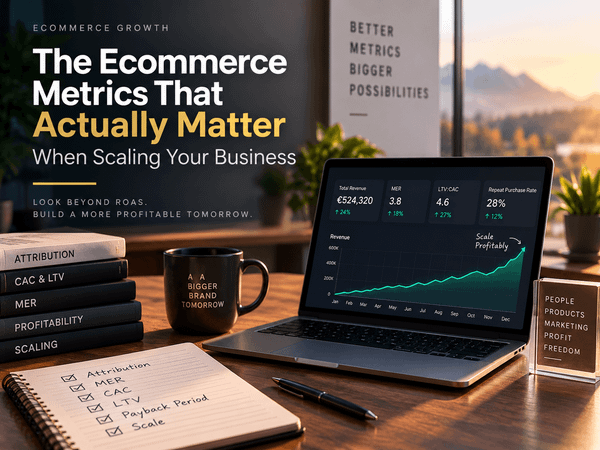
I cover the relationship between acquisition cost, MER, blended ROAS, customer lifetime value and scaling in my ecommerce metrics guide.
How to Find Reliable Alibaba Suppliers
Once you have identified a promising product, the next step is finding the supplier.
For this, Alibaba is one of the most useful platforms available. I have used it to source products for my own ecommerce businesses.
Alibaba gives small ecommerce operators access to an enormous network of manufacturers and trading companies, including suppliers offering competitive pricing, customisation and the ability to scale production.
But there is a right way and a wrong way to use it.
The wrong way is searching for a product, sorting by price and choosing the cheapest supplier. The right way is finding a company you can trust with your inventory, money and eventually your customers.
Start With Verified Suppliers
The first filter is supplier verification.
Alibaba's Verified Supplier programme provides additional supplier assessments conducted by third-party inspection organisations. Look at the verification details and available assessment reports, then investigate the company itself.
Verification is a useful starting point, but it does not guarantee that every product meets your quality requirements or the regulations of your target market. You still need to perform your own checks.
Check the Supplier's History and Reputation
I want to know whether I am dealing with an established business.
Has the company been operating for one year, five years or ten years? How long has it been active on Alibaba? Does it specialise in the type of product I want to sell?
Look at reviews, ratings, company information and transaction history. Pay attention to recurring complaints and how professionally the supplier communicates.
A long operating history does not guarantee quality, but it gives you more information than a newly established company with almost no track record.
Contact Several Suppliers
Do not automatically commit to the first supplier you find. Contact several companies offering comparable products and ask about:
- Minimum order quantity (MOQ)
- Unit prices at different quantities
- Samples and sample costs
- Manufacturing lead times
- Shipping options
- Packaging and customisation
- Product specifications and compliance documentation
This gives you a better picture of the market and helps you identify suppliers that are responsive, professional and interested in building a relationship.
Always Order a Sample
If you are working with a supplier for the first time, get a sample.
A product photograph tells you very little about actual quality. Get the product into your hands, use it and inspect the materials, stitching, packaging, finish, dimensions and anything else relevant.
Ask yourself whether you would be comfortable shipping this exact product to a paying customer under your own brand.
The sample also lets you test the supplier relationship. Did it arrive when promised? Was it consistent with the specifications? Did the supplier answer your questions properly?
You are evaluating both the product and the company supplying it.
Do Not Choose on Price Alone
The cheapest supplier is not necessarily the cheapest supplier to work with.
A manufacturer charging slightly more but delivering consistent quality may be far more valuable than one offering the lowest price but producing defective batches.
Poor quality creates refunds, replacements, negative reviews, customer-service work and damage to the brand.
You are not simply buying inventory. You are establishing a supply chain.
Before ordering, calculate the full landed cost:
Landed cost per unit = Product cost + Allocated freight + Duties + Other non-recoverable import costs
Use this number when calculating your margins, not simply the price shown on Alibaba.

Found a Winning Product? Start Selling.
Turn proven demand into real sales. Launch your ecommerce brand with Shopify.
How to Test a Winning Product Before Scaling
Finding a proven product and a reliable supplier gives you a strong starting position. But you still need to establish whether you can sell it profitably in your market.
A competitor's success does not automatically become your success. Your brand, price, website, creative and offer all influence the result.
Start With 10–50 Units, Not 1,000
If the supplier allows you to order 10 units, that may be enough for an initial test. If the minimum order quantity is 50, perhaps start with 50.
You will probably pay more per unit than if you ordered 1,000. That is fine.
The first order exists to reduce uncertainty, not maximise gross margin.
Suppose you buy 20 units and the test fails. You have learned something without creating a major inventory problem.
Now imagine buying 2,000 units because the supplier offered an excellent volume discount. If the test fails, you have tied up substantial working capital in products nobody is buying.
I started small with my own inventory rather than committing to enormous quantities from the beginning. It allowed me to fulfil orders quickly while learning how the market responded.
Can You Test a Product With Pre-Orders?
Yes. Pre-orders can make product validation even less capital-intensive.
You create the store, advertise the product and clearly communicate a longer delivery time. Suppose your website states an expected delivery time of 21–25 days.
You run Meta ads for a week and customers start placing orders. You now have evidence of purchase intent before committing heavily to inventory.
If the supplier can deliver quickly enough, you may be able to place the order after initial validation and still fulfil customers within the promised timeframe.
But suppliers can be delayed, customs can create problems and products can fail inspection. That is why I prefer bringing in a small quantity first when possible. Customers receive their orders faster, and the test is cleaner.
I have also seen a more aggressive approach where sellers accept orders they never intend to fulfil, then cancel and refund them simply to measure demand. I do not recommend this. If you accept an order, the intention should be to fulfil it.
Build the Product Test on Shopify
Once you have the product and sourcing strategy, build the store on Shopify.
For this branded ecommerce framework, Shopify is the platform to use.
You do not need to complicate your first ecommerce business by building custom infrastructure or maintaining a complicated technical stack.
Shopify provides the tools needed to launch, accept payments, manage products, fulfil orders and grow. More importantly, it lets you concentrate on the parts of the business that create sales: product, offer, brand, advertising, conversion and customer experience.
The platform itself is not the expensive part of getting started. Inventory, advertising, creative production and operating costs become more significant as the business grows.
For a comparison of the different ways to sell online, see my Shopify vs Etsy vs Amazon comparison.
Should You Use a Premium Shopify Theme?
You can test a product using a free Shopify theme, but for a serious branded ecommerce business, I recommend investing in a strong theme when the budget allows it.
Impact and Prestige are two options I like for this type of store.
The reason is trust. If your website looks like a generic dropshipping store assembled yesterday, customers might want the product but hesitate because they do not trust the business.
You then conclude that the product failed when the real problem was the presentation.
Your website needs to give the product a fair test. That means professional design, clear product information, strong photography, visible delivery terms, contact details and a credible offer.
I explain the structure in more detail in my Shopify landing page optimisation guide.
Build a Brand From Day One
Finding a product that somebody else already sells does not mean you should build a generic dropshipping website around it.
The correct long-term model is branded ecommerce.
You may initially source a product that other companies can also buy. That is normal. But your business needs its own identity: a recognisable name, logo, consistent colours, product photography, positioning and customer experience.
Give products distinctive names without misrepresenting who manufactures them or what makes them different. Then improve the products as the business grows.
Once you have demonstrated demand and started ordering larger quantities, work with the manufacturer on customisation.
Can you change the colour, improve a material, adjust the dimensions, create better packaging or solve a problem customers repeatedly mention?
Over time, the generic product becomes increasingly differentiated from the version you initially sourced.
That is how you move from selling a product to building a brand around it.
Don't Just Sell a Product. Build a Brand.
Build a real ecommerce business with the platform designed to grow with you.
Trust Is Part of the Product Test
A customer arriving from a Meta advertisement may have discovered your business 30 seconds earlier. They cannot physically inspect the product and do not know you.
They are being asked to trust your website with their money.
That is why branding matters immediately. Your store needs to communicate that this is a legitimate business with a real product, clear delivery expectations and someone who will respond if something goes wrong.
Your first store does not need to be perfect, but it must be credible. Otherwise, you are testing not only the product but also whether customers are willing to buy from a website they do not trust.
How to Test Your Product With Meta Ads
Once the store is ready and you have inventory available, start testing customer acquisition.
Meta is a natural starting point for many direct-to-consumer products because it allows you to introduce products to customers who may not already be searching for them.
But do not judge an entire product from one advertisement.
Create several creatives and test different ways of presenting the same product. One might focus on the problem, another might demonstrate the product and a third might show a customer using it.
You are testing whether the market responds to the product and offer, not simply whether one video performs well.
Calculate Your Target Customer Acquisition Cost
Before spending money, calculate how much you can afford to pay for a customer.
Start with your contribution before advertising.
Pre-ad contribution = Net order revenue − Product cost − Fulfilment cost − Payment fees − Other variable order costs
Suppose a product sells for 500 DKK excluding VAT.
The order can support up to 315 DKK in advertising costs before first-order contribution reaches zero. But you still need to cover fixed costs and generate profit.
Break-even first-order CAC = Pre-ad contribution per first order
Break-even first-order CAC = 315 DKK
If you want to retain 100 DKK per order for fixed costs and profit:
Target CAC = 315 − 100 = 215 DKK
Now you have an actual acquisition target rather than an arbitrary ROAS number.
Calculate Your Break-Even ROAS
You can express the same economics through ROAS.
Break-even ROAS = Net order revenue ÷ Pre-ad contribution
Break-even ROAS = 500 ÷ 315 = 1.59
At approximately 1.59 ROAS, the order breaks even on the included variable costs and advertising, before fixed overhead.
To retain 100 DKK per order:
Target ROAS = 500 ÷ 215 = 2.33
These are simplified first-order calculations. Repeat purchasing and customer lifetime value can change the economics, but do not assume future purchases that have not yet happened.
How Much Should You Spend Testing?
There is no universal test budget. A product selling for 300 DKK has different economics from one selling for 1,500 DKK.
Your target acquisition cost should determine the budget.
Suppose your target CAC is 200 DKK. Spending 100 DKK and receiving no sales tells you almost nothing.
As an illustrative starting point, you might allocate enough budget to test several potential acquisitions and multiple creative angles.
Initial test budget = Target CAC × 5
Initial test budget = 200 × 5 = 1,000 DKK
This is a budgeting illustration, not a statistically reliable pass-or-fail threshold. Five expected acquisitions are not enough to establish performance with high confidence.
The principle is to avoid making decisions from insignificant amounts of traffic while also avoiding endless spending on a product that is not responding.
How to Know Whether the Product Test Is Working
Do not look only at sales. Look at what customers do between seeing the advertisement and completing the purchase.
Three metrics matter particularly during the initial test.
Conversion rate = Orders ÷ Visitors × 100
If 500 visitors produce 10 orders, your conversion rate is 2%.
CAC = Acquisition spend ÷ New customers acquired
If you spend 2,000 DKK and acquire eight new customers, your CAC is 250 DKK.
Contribution after advertising = Pre-ad contribution − CAC
If your pre-ad contribution is 315 DKK and your CAC is 250 DKK, you have 65 DKK remaining per newly acquired customer to contribute towards fixed costs and profit.
That tells you far more than simply celebrating eight sales.
What If the Test Fails?
First check whether the problem is obvious and fixable.
Was the website untrustworthy? Was the price unreasonable? Was the advertising creative poor? Were shipping costs unexpectedly high?
If there is a clear problem, fix it and test again within a sensible budget.
But if the economics remain poor and the market does not respond, stop.
Do not spend six months trying to force a product to become successful.
This is also why the initial inventory order was small. If you have 15 units left, you can discount them, bundle them with another product or potentially use them as gifts with future purchases where appropriate.
A product that fails as a standalone offer can sometimes still create value as part of a better offer. I explain this approach in my product bundling strategy guide.
Twenty failed units are a relatively inexpensive lesson. Two thousand failed units can become a serious working-capital problem.
Turn your product into a real ecommerce business. Launch your branded Shopify store and start making sales.
When Should You Scale a Winning Product?
A few sales are not enough to justify immediately ordering thousands of units.
You need evidence that the product can repeatedly acquire customers at economics that work. Look for consistent purchasing behaviour, viable CAC, sufficient contribution and a supplier capable of maintaining quality as quantities increase.
Then scale progressively. Increase inventory in line with demand, expand advertising creatives, improve the offer, optimise the product page and develop complementary products.
But remember that even a profitable product can create cash-flow problems.
Your supplier may require payment before production. Shipping takes time, and advertising continues consuming cash while inventory is in transit.
If you scale too aggressively, you can run out of working capital while the business is technically profitable.
The goal is not simply to generate more orders. It is to build a business that can fulfil those orders, replenish inventory and continue acquiring customers without running out of cash.
The Complete Winning Product Framework
Here is the sequence I would follow when starting another branded ecommerce business.
The order matters. Do not build a complicated store before finding the product, order large quantities before testing demand or scale advertising before understanding your economics.
Frequently Asked Questions
How Do You Find Winning Products for Ecommerce?
Find products with proven demand and investigate whether your market has room for another competitor. Use Meta Ad Library, competitor websites, Google searches and ecommerce product-research tools. Look for sustained advertising activity, evaluate saturation and check whether the product has sufficient margins and manageable logistics.
How Do You Find Winning Products for Shopify?
Start with product research before building the Shopify store. Identify proven demand, evaluate competition, source a sample through a reputable supplier and calculate your acquisition economics. Once the product passes those checks, create a branded Shopify store and test with a small inventory order.
What Is the Best Way to Find Products to Sell Online?
The strongest starting point for a beginner is an existing product with demonstrated demand and limited competition in the target market. This reduces the uncertainty involved in launching a completely new category while leaving room to develop a differentiated brand.
Is Alibaba Safe for Ecommerce Product Sourcing?
Alibaba is a useful sourcing platform when suppliers are properly vetted. Start with verified suppliers, investigate operating history, review company information, request documentation where relevant and always order a sample before committing to a meaningful quantity. Supplier verification does not replace independent quality and compliance checks.
How Much Inventory Should You Buy to Test a Product?
Buy the smallest quantity that allows you to perform a legitimate market test and fulfil customer orders. For some products that may be 10 units; for others, 50. The first order should minimise the cost of being wrong.
The Bottom Line
The product comes first. You can improve a website, fix advertising, change fulfilment partners and build better customer service as the business grows. But none of those things can manufacture sustainable demand for a product nobody wants.
So do not start your first ecommerce business by trying to invent demand.
Find demand that already exists.
Find a product people are buying, identify a market where there is still room, check the economics and source it properly. Then build a credible Shopify brand and test with real customers before committing significant capital.
If it works, scale. If it does not, learn cheaply and move on.
For a beginner, being early to a proven product in an underserved market is often a far better opportunity than trying to be the first person in the world to invent something new.
Your next action: Find five products being advertised consistently on Meta. Research their competitors, estimate their economics and shortlist the one with the strongest combination of demand, margin and market opportunity.