Triple Whale vs Reaktion (2026): I Used Both. Here's The Difference.

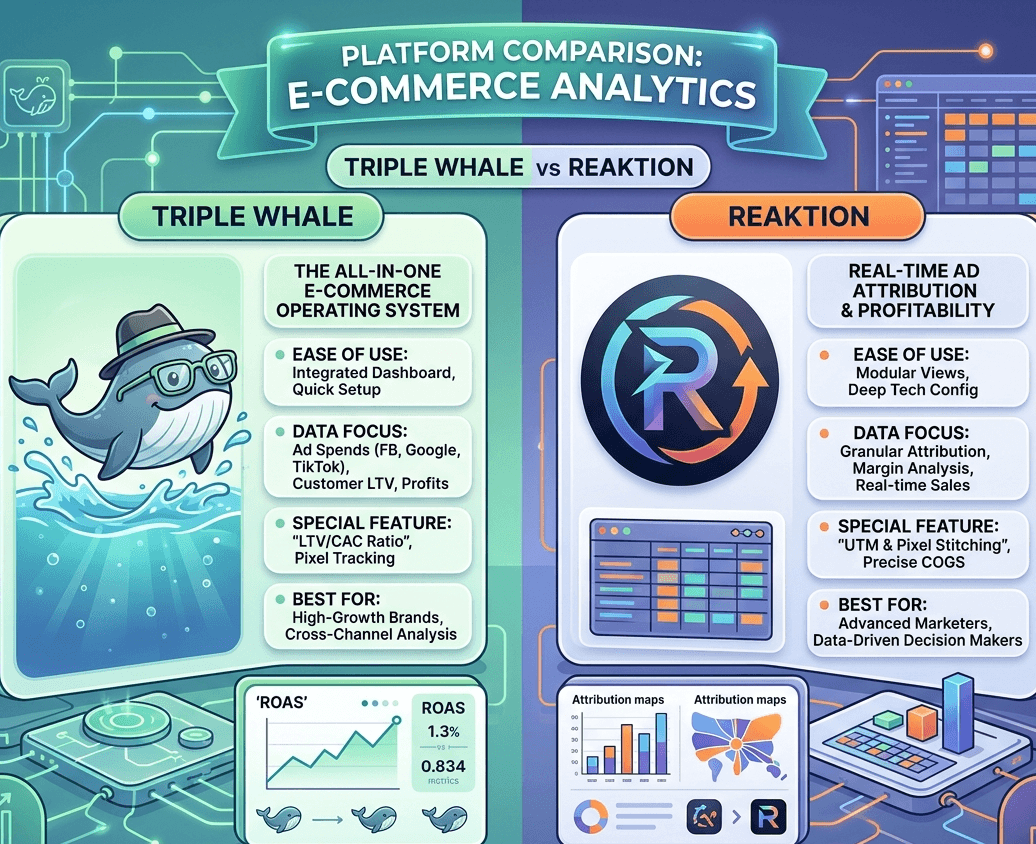
One tells you what happened. One tells you what to do about it.
TL;DR: Triple Whale is the winner. I used both on a real Shopify store — started on Reaktion, switched to Triple Whale on the recommendation of one of the top 3 ecommerce bureaus in Denmark — and the gap between them is significant. Reaktion is a solid tracking tool (8/10). Triple Whale is an entirely different category: unified analytics, AI-powered intelligence through Moby, Sonar signal quality that directly improves your paid ads, and automation potential I haven't seen matched anywhere else. It scores 9/10 and it's not close. The only real question is whether your store is ready for it yet.
How I Found Both Tools
I didn't find these tools by googling "best Shopify analytics tool."
Both Reaktion and Triple Whale were recommended to me directly by my ecommerce bureau — arguably one of the top 3 ecommerce bureaus in Denmark. That matters. When an agency operating at that level recommends a tool, and then later recommends you switch to a different one, you pay attention.
I started on Reaktion. Then I switched to Triple Whale. Here's what I learned from using both on a real Shopify store running paid ads on Meta and Google.
Is Reaktion a Real Triple Whale Alternative?
Both platforms overlap in dashboards and attribution reporting. But the question ecom store owners should be asking isn't "which one has more features."
The right question is: which one generates the value my business needs right now?
That's the lens I'm using for this comparison. Not hype. Not feature lists. Value. And if you're researching Shopify analytics tools trying to decide between the two — that's exactly what this post answers.
Reaktion: Tracking Accuracy First
My score: 8/10
Reaktion's core value starts at the data layer — and for Shopify analytics, that foundation matters more than most store owners realise.
It uses server-side tracking to capture more conversions across Google, Meta, TikTok, GA4 and Klaviyo — bypassing ad blockers, iOS restrictions and browser limitations that break standard pixel tracking. In practice, this means what you measure is closer to reality. And if your tracking layer is weak, everything above it becomes unreliable.
What Reaktion does well:
- Server-side tracking for more accurate conversion data
- Sends actual profit data — factoring in COGS, returns and refunds — directly to ad platform algorithms
- Google Shopping Labelizer: label products based on POAS, return rates, new releases or dead stock
- Clean, straightforward performance reporting
- Strong agency module for managing multiple clients
- Order-based pricing that starts at €70/month
The Google Shopping Labelizer deserves a specific mention. For stores with varying margins across their product catalog, this is where a lot of wasted Google Shopping spend gets recovered. Triple Whale doesn't touch this.
What Didn't Work for Me With Reaktion
Reaktion is honest about what it is: a tracking and reporting tool. But that's also its ceiling.
There's no AI assistant. No creative-level performance insights. No marketing automation layer. If you want to understand why a campaign worked or get suggestions on what to do next, you're on your own. For a store actively scaling paid ads, that gap starts to feel significant — and it's ultimately why I switched.
In short: Reaktion tells you what happened — and makes sure that data is as accurate as possible.
Triple Whale: Intelligence and Activation
My score: 9/10
Triple Whale's core value is fundamentally different.
Where Reaktion focuses on tracking accuracy, Triple Whale focuses on turning your Shopify analytics data into a unified business picture — and then helping you act on it.
Sonar
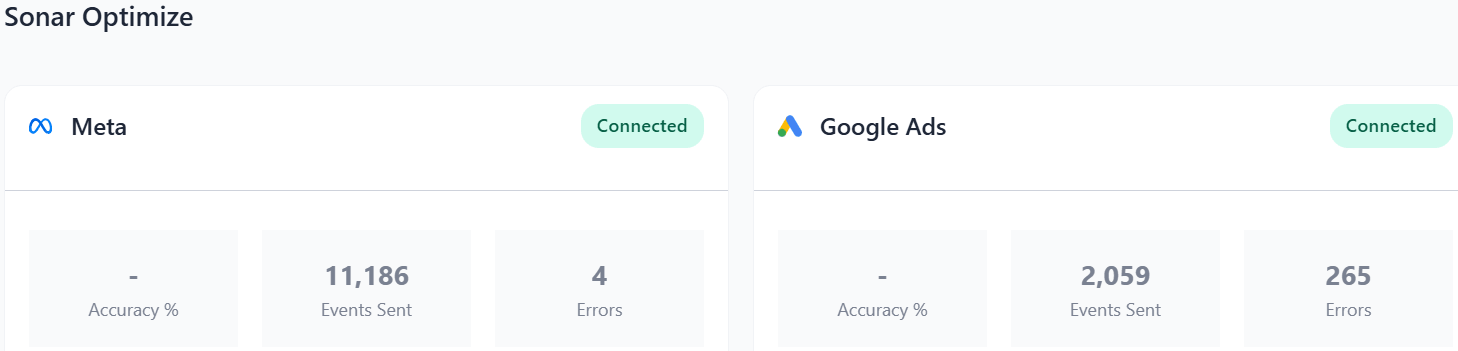
Sonar is one of the main reasons I switched from Reaktion to Triple Whale.
Sonar sends significantly more and better data back to your marketing campaign algorithms. If you're running Meta or Google ads, that means the algorithm has more signal to work with. More signal means better optimization. Better optimization means better results.
For stores actively scaling paid ads, this alone can generate returns that dwarf the price difference between the two tools.
Moby and Moby 2
Moby is Triple Whale's AI assistant and it is genuinely impressive.
Instead of spending hours digging through dashboards trying to figure out what's going on in your store, you can simply ask Moby. It knows your store data, understands ecommerce, and gives you answers that are actually useful — budget reallocation suggestions, creative briefs, audience recommendations, lifecycle triggers and inventory insights.
Moby 2 is faster, more capable and more accurate. If you've used Moby and thought it was good, Moby 2 is better.
Creative Cockpit
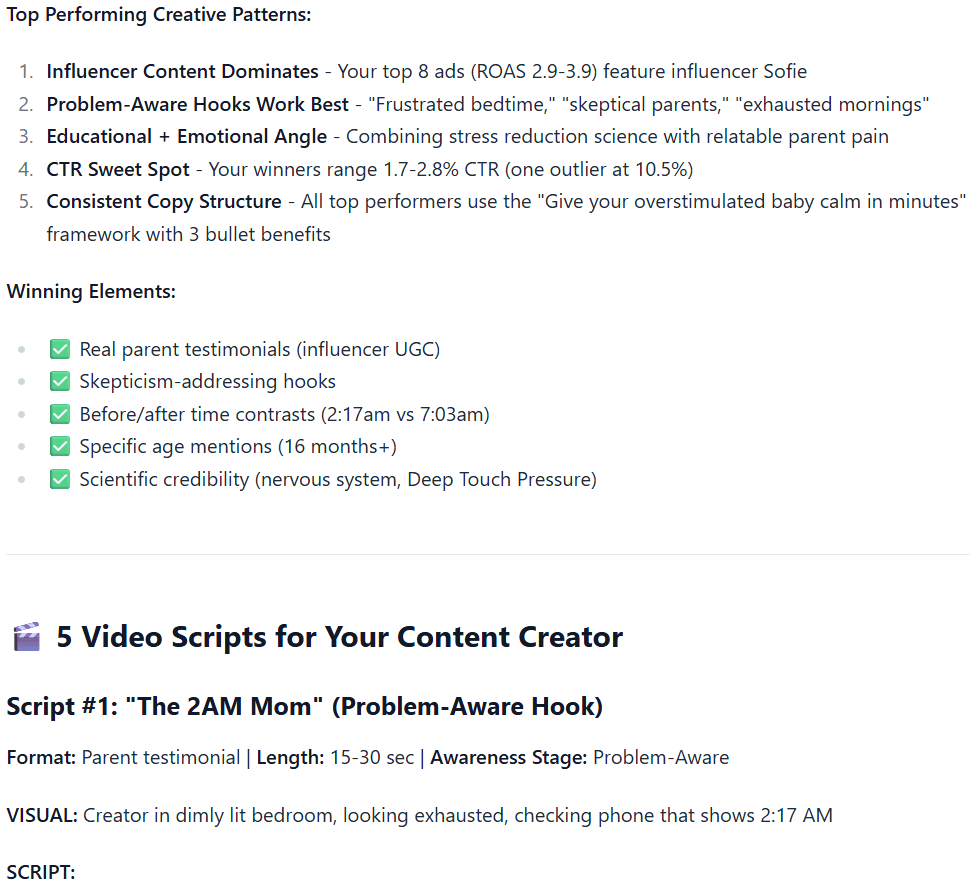
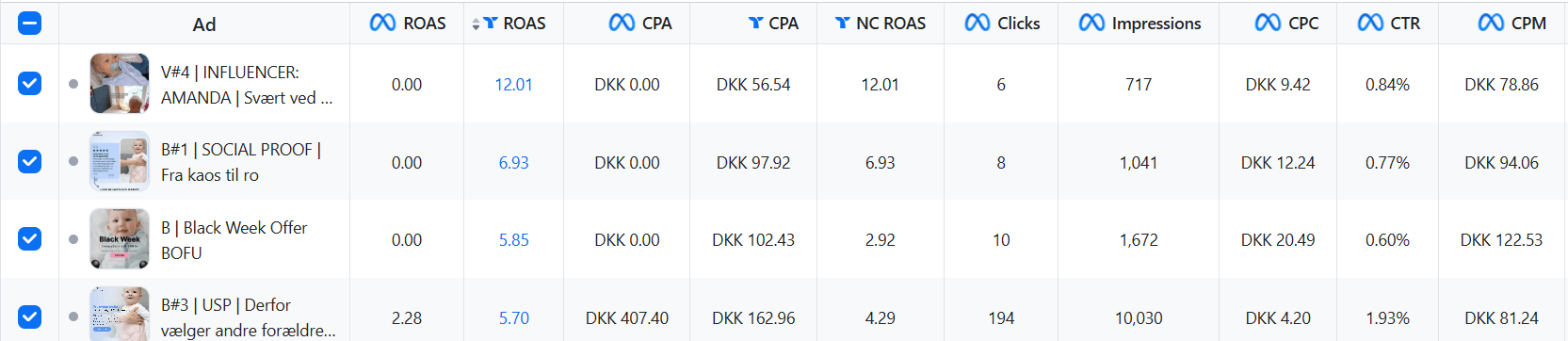
Triple Whale's Creative Cockpit gives you ROI insights at the ad creative level — image, copy and video. You can see exactly what's working across your full creative library on Meta and Google. For stores running large volumes of ads, this alone saves significant time and budget. I've used this directly to kill underperforming creatives faster and reallocate budget without guessing.
Marketing Automation
This is where Triple Whale gets genuinely interesting. If you stitch together your agents carefully, you can automate significant parts of your marketing operation — not simple rules-based automations, but an intelligent system that can run real decisions. Building that setup takes thought and effort, but the potential is there. And when Triple Whale is connected to a solid email platform — Klaviyo is the obvious choice for Shopify stores — the automation loop between paid and owned channels becomes genuinely powerful.
What Didn't Work for Me With Triple Whale
Two honest things worth flagging.
First, the GMV-based pricing can catch you off guard as you scale. GMV is calculated on total products sold before any deductions — so a store doing $300k in GMV but $50k in returns is still priced at the $300k tier. Something to factor in when projecting costs.
Second, Triple Whale's attribution model is proprietary. It blends pixel data, platform API data, and modeled attribution into a single number. For most store owners that's fine. But if your CFO starts asking exactly how that ROAS number is calculated, the honest answer is "trust the model." Reaktion's first-party, channel-verified data is more transparent in this regard.
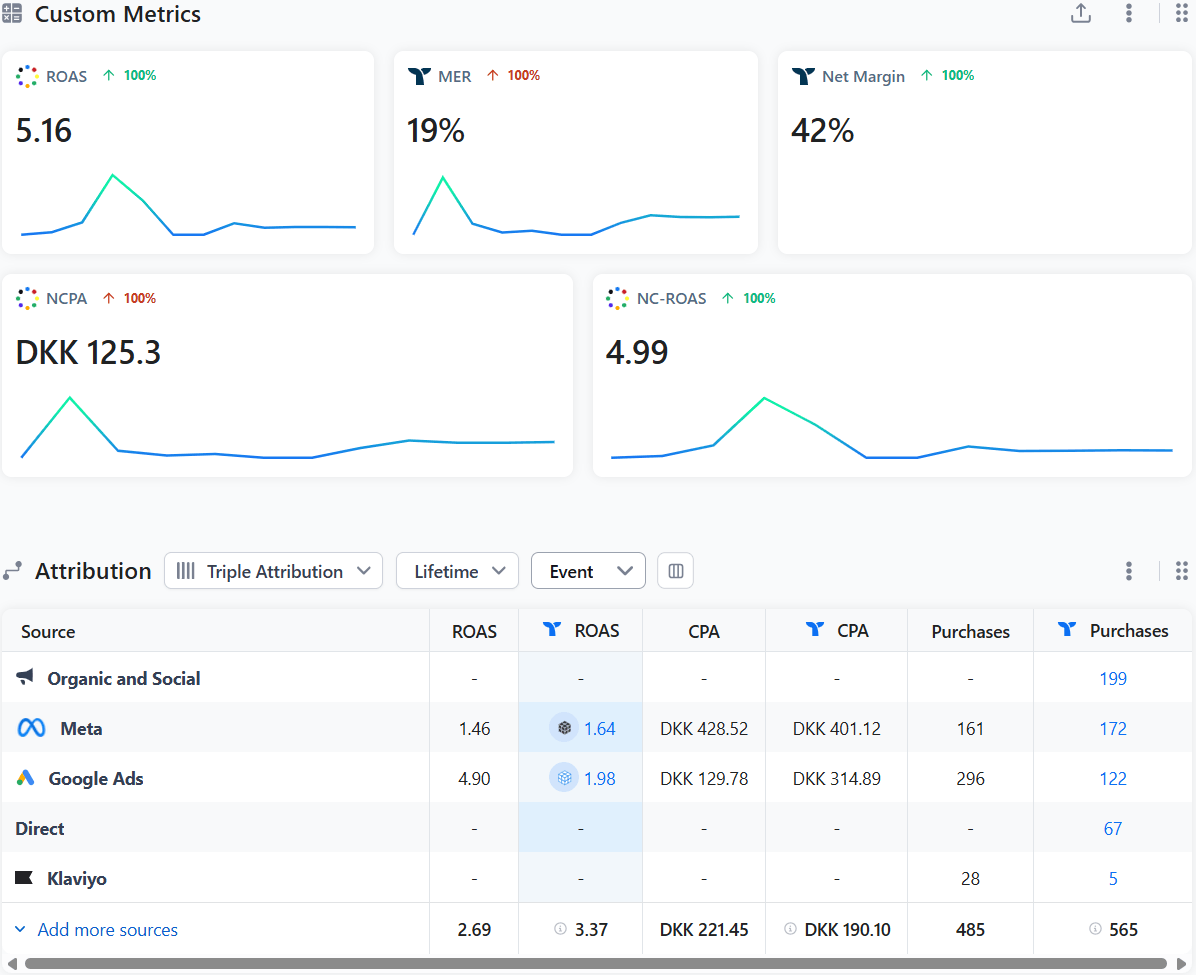
In short: Triple Whale tells you what to do about it — and then helps you do it.
Pricing: What You Actually Pay
Reaktion starts at €70/month for up to 250 orders. Pricing is order-based — your costs increase as your order volume grows. Predictable if your volume is stable. Worth monitoring as you scale.
Triple Whale starts at $149/month for stores with under $250k GMV in the last 12 months.
A quick note on GMV — Gross Merchandise Value is the total value of all products sold before any deductions like returns, refunds or fees. It sits above your gross revenue and significantly above your net revenue. Triple Whale's pricing is GMV-based, meaning your tier is determined by your top-line sales number, not what you actually keep.
| Reaktion | Triple Whale | |
|---|---|---|
| Entry price | €70/month | $149/month |
| Pricing model | Order-based | GMV-based |
| Scales with | Order volume | Total revenue |
| Entry level limit | 250 orders/month | $250k GMV/year |
The Honest Comparison
| Reaktion | Triple Whale | |
|---|---|---|
| Core mechanism | Server-side tracking + profit signals | Unified analytics + AI insights |
| Performance tracking | ✅ | ✅ |
| Attribution transparency | First-party data, channel verified | Proprietary blended model |
| AI assistant | ❌ | ✅ Moby & Moby 2 |
| Marketing data feed | Limited | ✅ Sonar |
| Creative analysis | Profit per creative | Full Creative Cockpit |
| Google Shopping | ✅ Labelizer | ❌ |
| Marketing automation | ❌ | ✅ |
| Entry pricing | €70/month | $149/month |
| Pricing model | Order-based | GMV-based |
| Best for | Tracking accuracy + early stage | Scaling + paid marketing |
| My score | 8/10 | 9/10 |
| Founded | 🇩🇰 Denmark | 🇺🇸 USA |
Do You Need Both?
For most stores: no. Triple Whale is the answer.
The only real case for starting with Reaktion is if you're early stage, order volume is low, and $149/month is a meaningful budget constraint right now. In that case, Reaktion's €70/month entry price and order-based model makes sense as a starting point — and the Google Shopping Labelizer alone can pay for itself.
But if you're running serious paid ad spend on Meta or Google, start with Triple Whale and don't look back.
- Early stage, budget constrained → Reaktion first. Read my full Reaktion review to see if it fits.
- Actively scaling paid ads → Triple Whale, full stop. My full Triple Whale review covers every feature in detail.
- Want the full analytics landscape → my analytics and attribution overview covers the wider picture.
My Verdict
Triple Whale: 9/10 — Clear Winner
This is not a close call. Sonar feeds your marketing algorithms better data than anything else I've used. Moby and Moby 2 give you AI-powered insights on demand — no more digging through dashboards trying to figure out what happened. Creative Cockpit shows you exactly what's working across your full ad library. And the automation potential is something I genuinely haven't seen matched anywhere else in this space.
If you're serious about scaling paid ads on Shopify, you're going to end up at Triple Whale eventually. You might as well start there and stop paying for the education twice.
Reaktion: 8/10 — Good Tool, Narrower Job
Reaktion is not a bad tool — I want to be clear about that. The server-side tracking accuracy, POAS-first reporting, Google Shopping Labelizer and order-based pricing make it the right call for stores that need clean data before they need intelligence. I don't regret starting there. But it has a ceiling, and most growing stores hit it faster than they expect.
Bottom line: Use Triple Whale. If budget is a genuine constraint right now, start with Reaktion and plan the switch. But if you're serious about your Shopify analytics setup and want it to actually drive better marketing decisions — Triple Whale is where you're headed regardless.
Frequently Asked Questions
Is Triple Whale better than Reaktion? Yes — Triple Whale is the better tool for most Shopify stores actively running paid ads. It scores 9/10 vs Reaktion's 8/10. Reaktion wins on tracking transparency and Google Shopping optimization, but Triple Whale's Sonar, Moby AI and Creative Cockpit operate on a different level entirely. The only scenario where Reaktion is the right first choice is if you're early-stage and budget is genuinely tight.
What is GMV and why does it matter for Triple Whale pricing? GMV stands for Gross Merchandise Value — the total value of all products sold before any deductions. Triple Whale's pricing is GMV-based meaning your costs increase as your store grows. A store with $300k GMV but $50k in returns is still charged at the $300k tier.
What is Triple Whale Sonar? Sonar is a Triple Whale feature that sends significantly more and better data back to your marketing campaign algorithms — particularly Meta and Google. More data means better algorithm optimization and better campaign performance. It's one of the main reasons I switched from Reaktion to Triple Whale.
What is Triple Whale Moby? Moby is Triple Whale's AI assistant trained on your store data. It answers questions about your business performance in plain language, delivers budget reallocation suggestions, creative briefs and audience recommendations. Moby 2 is the latest and most capable version.
What is Reaktion's Google Shopping Labelizer? The Labelizer lets you label products in your Google Shopping feed based on POAS, return rates, new releases or dead stock. For stores with varying margins across their product catalog, this is where a lot of wasted Google Shopping spend gets recovered. Triple Whale doesn't have an equivalent feature.
Is Reaktion cheaper than Triple Whale? At entry level, Reaktion starts at €70/month for up to 250 orders and Triple Whale starts at $149/month for stores under $250k GMV. The more important difference is the pricing model — Reaktion scales with order volume while Triple Whale scales with GMV.
Can Triple Whale automate my marketing? Theoretically yes. By carefully connecting Triple Whale's agents together you can automate significant parts of your marketing operation. It requires setup and thought but the potential is genuinely impressive.
Is Reaktion good for Danish ecommerce stores? Yes. Reaktion was founded by a Danish team and understands the Danish market. Its order-based pricing, server-side tracking and clean performance reporting make it a strong choice for Danish ecommerce stores at any stage.